
The Sahasranama
The Thousand Divine Names
Of 1008
-
Verse 1Śmaśānakālikā Kālī Bhadrakālī Kapālinī |Guhyakālī Mahākālī Kurukullāvirodhinī
- Śmaśānakālikā – She Who Is The Remover Of Darkness From The Cremation Grounds Or From Death1
- Kālī – She Who Is The Remover Of Darkness2
- Bhadrakālī – She Who Is The Excellent Remover Of Darkness3
- Kapālinī – She Who Is The Bearer Of The Skulls Of Impurity4
- Guhyakālī – She Who Is The Hidden Or Secretive Remover Of Darkness5
- Mahākālī – She Who Is The Great Remover Of Darkness6
- Kurukullāvirodhinī – She Who Confronts The Forces Of Duality7
-
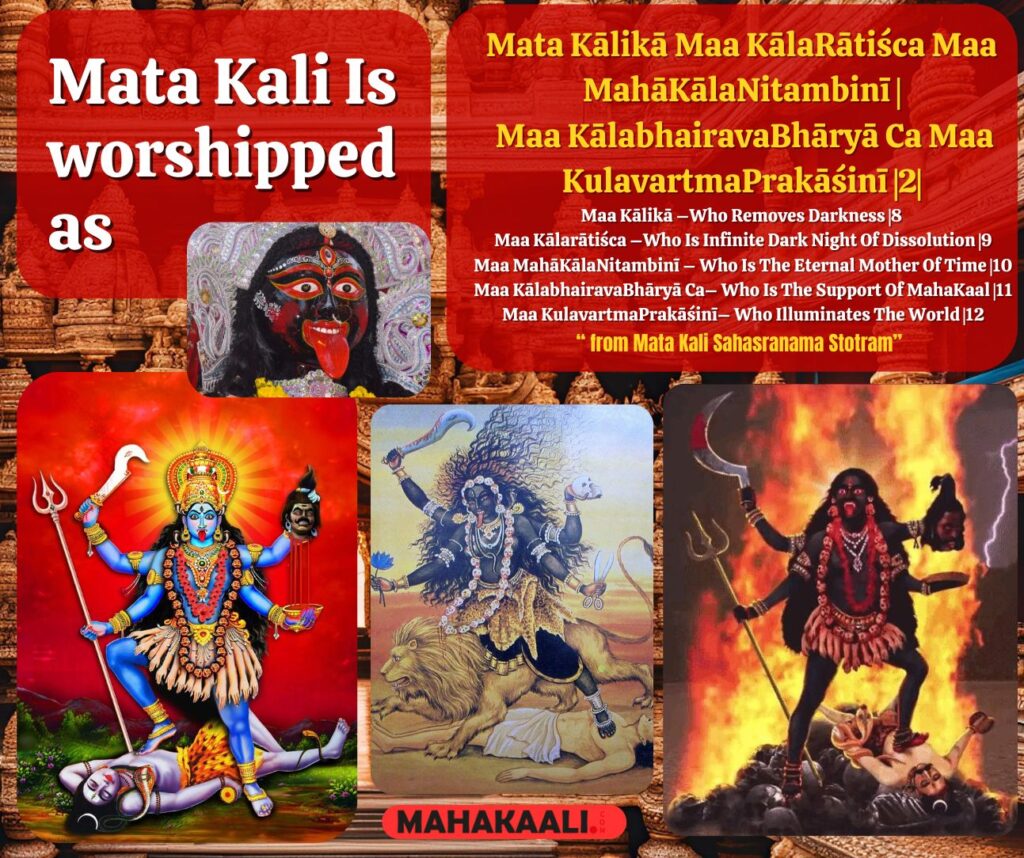
Verse 2Kālikā Kālarātiśca Mahākālanitambinī |Kālabhairavabhāryā Ca Kulavartmaprakāśinī
- Kālikā – She Who Is The Cause Of Removing The Darkness8
- Kālarātiśca – She Who Is The Dark Night Of Egotism And…9
- Mahākālanitambinī – She Who Is The Eternal Mother Of Great Time10
- Kālabhairavabhāryā Ca– She Who Is The Wife Of The Fearfulness Of Infinite Time And…11
- Kulavartmaprakāśinī– She Who Illuminates The Whole World Family12
-
Verse 3Kāmadā Kāminī Kāmyā Kamanīyasvabhāvinī |Kastūrīrasaliptāṅgī Kuñjareśvaragāminī
- Kāmadā– She Who Is The Giver Of All Desire13
- Kāminī– She Who Is The Giver Of This Desire14
- Kāmyā– She Who Is Desired15
- Kamanīyasvabhāvinī– She Who Is The Intrinsic Nature Of That Which Is Desired16
- Kastūrīrasaliptāṅgī– She Whose Limbs Are Anointed With The Juice Of Musk17
- Kuñjareśvaragāminī– She Who Moves Like The Lord Of Elephants (Indra’s Airāvata)18
-
Verse 4Kakāravarṇasarvāṅgī Kāminī Kāmasundarī |Kāmārtā Kāmarūpā Ca Kāmadhenuḥ Kalāvatī
- Kakāravarṇasarvāṅgī– She Who Is All The Limbs Of The Letter “Ka”, The Cause19
- Kāminī– She Who Is This Desire20
- Kāmasundarī– She Who Is Beautiful Desire21
- Kāmārtā– She Who Is The Object Of Desire22
- Kāmarūpā Ca– She Who Is The Form Of Desire And…23
- Kāmadhenuḥ– She Who Is The Cow Which Fulfills All Desires24
- Kalāvatī– She Who Is The Repository Of All Qualities Or Arts25
-
Verse 5Kāntā Kāmasvarūpā Ca Kāmākhyā Kulapālinī |Kulīnā Kulavatyambā Durgā Durgārtināśinī
- Kāntā– She Who Is Beauty Enhanced By Love26
- Kāmasvarūpā Ca– She Who Is The Intrinsic Form Of Desire And…27
- Kāmākhyā– She Whose Name Is Desire28
- Kulapālinī– She Who Protects Excellence29
- Kulīnā– She Who Is Excellence30
- Kulavatyambā– She Who Is The Repository Of Excellence31
- Durgā– She Who Is The Reliever Of Difficulties32
- Durgārtināśinī– She Who Is The Destroyer Of All Various Difficulties33
-
Verse 6Kumārī Kulajā Kṛṣṇā Kṛṣṇadehā Kṛśodārā |Kṛśāṁgī Kuliśāṁgī Ca Krīṁkārī Kamala Kalā
- Kumārī– She Who Is Ever Pure34
- Kulajā– She Who Is Gives Birth To Excellence35
- Kṛṣṇā– She Who Manifests All Action36
- Kṛṣṇadehā– She Who Has A Dark Body37
- Kṛśodārā– She Who Is Holds Aloft All Action38
- Kṛśāṁgī– She Who Is Embodies All Action39
- Kuliśāṁgī Ca– She Who Is The Embodiment Of Excellence And…40
- Krīṁkārī– She Who Is Causes Dissolution Of The Subtle Body Into The Causal Body41
- Kamala– She Who Is A Lotus (Lakṣmi)42
- Kalā– She Who Is Art Or All Attributes43
-
Verse 7Karālāsyā Karālī Ca Kulakāntā-Parājitā |Ugrā Ugraprabhā Dīptā Vipracittā Mahānanā
- Karālāsyā– She Who Has A Gaping Mouth44
- Karālī Ca– She Who Dissolves All Into Her Being And…45
- Kulakāntā-Parājitā– She Whose Excellent Beauty Is Undefeated46
- Ugrā– She Who Is Terrible47
- Ugraprabhā– She Whose Light Is Terrible48
- Dīptā– She Who Is Light49
- Vipracittā– She Whose Objects Of Consciousness Are Varied50
- Mahānanā– She Who Has A Great Face51
-
Verse 8Nīlāghanā Valākā Ca Mātrā Mudrāmitāsitā |Brāhmī Nārāyaṇī Bhadrā Subhadrā Bhaktavatsalā
- Nīlāghanā– She Who Has The Complexion Of A Dark Cloud52
- Valākā Ca– She Who Exemplifies The Freedom Of A Swan And…53
- Mātrā– She Who Is Verse54
- Mudrāmitāsitā– She Whose Positions Of Her Limbs Are Extremely Elegant55
- Brāhmī– She Who Is Creative Energy56
- Nārāyaṇī– She Who Is The Exposer Of Consciousness57
- Bhadrā– She Who Is Excellent58
- Subhadrā– She Who Is The Excellent Of Excellence59
- Bhaktavatsalā– She Who Nourishes All Devotees60
-
Verse 9Māheśvarī Ca Cāmuṇdā Vārāhī Nārasiṁhikā |Vajrāṅgī Vajrakaṅkālī Nṛmuṇdasragviṇī Śivā
- Māheśvarī Ca– She Who Is The Great Seer Of All And…61
- Cāmuṇdā– She Who Moves In The Paradigm Of Consciousness62
- Vārāhī– She Who Is The Boar Of Sacrifice63
- Nārasiṁhikā– She Who Is The Ferocious Half Human Half Lion Of Courage64
- Vajrāṅgī– She Who Has Limbs Of Lightning65
- Vajrakaṅkālī– She Whose Head Shines Like Lightning66
- Nṛmuṇdasragviṇī– She Who Is Adorned By A Garland67
- Śivā– She Who Is The Energy Of The Consciousness Of Infinite Goodness68
-
Verse 10Mālinī Naramuṇdālī Galatrudhirabhūṣaṇā |Raktacandanasiktāṅgī Sindūrāruṇamastakā
- Mālinī– She Who Wears A Garland Of Skulls69
- Naramuṇdālī– She Who Holds The Head Of A Man70
- Galatrudhirabhūṣaṇā– From Thegarland Of Skulls Around Her Neck Fall Drops Of Blood71
- Raktacandanasiktāṅgī– She Whose Limbs Are Covered By Red Sandal Paste72
- Sindūrāruṇamastakā– She Whose Forehead Is Marked With The Vermillion Of Love Which Brings The Light Of Wisdom73
-
Verse 11Ghorarūpā Ghoradaṁṣṭrā Ghorāghoratarā Śubhā |Mahādaṁṣṭrā Mahāmāyā Sudantī Yugadanturā
- Ghorarūpā– She Who Is Of Fearful Form74
- Ghoradaṁṣṭrā– She Whose Teeth Are Fearful75
- Ghorāghoratarā– She Who Is Auspiciousness Which Takes Beyond Inauspiciousness76
- Śubhā– She Who Is Pure77
- Mahādaṁṣṭrā– She Who Has Great Teeth78
- Mahāmāyā– She Who Is The Great Definition Of Consciousness79
- Sudantī– She Who Has Excellent Teeth80
- Yugadanturā– She Who Is Beyond The Ages Of Time81
-
Verse 12Sulocanā Virūpākṣī Viśālākṣī Trilocanā |Śāradenduprasannāsyā Sphuratsmerāmbujekṣaṇā
- Sulocanā– She Who Has Beautiful Eyes82
- Virūpākṣī– She Whose Eyes Are Of Indescribable Form83
- Viśālākṣī– She Who Has Great Eyes84
- Trilocanā– She Who Has Three Eyes85
- Śāradenduprasannāsyā– She Who Is Pleased As The Autumn Moon86
- Sphuratsmerāmbujekṣaṇā– She Whose Purity Shines In Her Lotus Eyes87
-
Verse 13Aṭṭahāsaprasannāsyā Smeravaktrā Subhāṣiṇī |Prasannapadmavadanā Smitāsyā Priyabhāṣiṇī
- Aṭṭahāsaprasannāsyā– She Who Has A Great Laugh In Extreme Pleasure88
- Smeravaktrā– She Who Speaks Words Of Remembrance89
- Subhāṣiṇī– She Who Has Excellent Expression90
- Prasannapadmavadanā– She Whose Lotus Lips Smile91
- Smitāsyā– She Whose Face Is Always Happy92
- Priyabhāṣiṇī– She Who Is The Beloved Expression Of Love93
-
Verse 14Koṭarākṣī Kulaśreṣṭhā Mahatī Bahubhāṣiṇī |Sumatiḥ Kumatiścaṇdā Caṇdamuṇdātiveginī
- Koṭarākṣī– She Whose Eyes Are Infinite94
- Kulaśreṣṭhā– She Who Is The Excellent Of Excellence Or Of Excellent Family95
- Mahatī– She Who Has A Great Mind96
- Bahubhāṣiṇī– She Who Has Various Expressions97
- Sumatiḥ– She Who Has An Excellent Mind98
- Kumatiḥ - She Who Has A Devious Mind99
- Caṇdā– She Who Is Passion100
- Caṇdamuṇdātiveginī– She Who Destroys Passion, Meanness And Other Negativities101
-
Verse 15Pracaṇdacaṇdikā Caṇdī Caṇdikā Caṇdaveginī |Sukeśī Muktakeśī Ca Dīrghakeśī Mahatkucā
- Pracaṇdacaṇdikā– She Who Is Great Terrible Passion102
- Caṇdī– She Who Tears Apart Thought103
- Caṇdikā– She Who Is The Cause Of Tearing Apart All Thought104
- Caṇdaveginī– She Who Destroys All Passion105
- Sukeśī– She Who Has Beautiful Hair106
- Muktakeśī Ca– She Who Has Unbound Hair And…107
- Dīrghakeśī– She Who Has Long Hair108
- Mahatkucā– She Who Has Large Breasts109
-
Verse 16Pretadehakarṇapūrā Pretapāṇisumekhalā |Pretāsanā Priyapretā Pretabhūmikṛtālayā
- Pretadehakarṇapūrā– She Who Has The Ears Of The Cosmic Body110
- Pretapāṇisumekhalā– She Who Has The Hands And Waist Of The Cosmic Body111
- Pretāsanā– She Who Sits With Disembodied Spirits112
- Priyapretā– She Who Is The Beloved Of Disembodied Spirits113
- Pretabhūmikṛtālayā– She Who Is The Land Where Disembodied Spirits Reside114
-
Verse 17Śmaśānavāsinīpuṇyā Puṇyadā Kulapaṇditā |Puṇyālayā Puṇyadehā Puṇyaślokā Ca Pāvinī
- Śmaśānavāsinī – She Who Resides In The Cremation Grounds115
- Puṇyā– She Who Is Merit116
- Puṇyadā– She Who Is The Giver Of Merit117
- Kulapaṇditā– She Who Is The One Of Excellent Knowledge118
- Puṇyālayā– She Who Is The Residence Of Merit119
- Puṇyadehā– She Who Embodies Merit120
- Puṇyaślokā Ca– She Whose Every Utterance Is Merit And…121
- Pāvinī– She Who Blows Like A Fresh Breeze122
-
Verse 18Pūtā Pavitrā Paramā Purāpuṇyavibhūṣaṇā |Puṇyanāmnī Bhītiharā Varadā Khaṅgapālinī
- Pūtā– She Who Is The Daughter123
- Pavitrā– She Who Is Pure124
- Paramā– She Who Is Supreme125
- Purāpuṇyavibhūṣaṇā– She Who Illuminates The Fullest Merit126
- Puṇyanāmnī– She Whose Name Is Meritorious127
- Bhītiharā– She Who Takes Away Fear And Doubt128
- Varadā– She Who Is The Grantor Of Boons129
- Khaṅgapālinī– She Who Has The Sword Of Wisdom In Her Hand130
-
Verse 19Nṛmuṇdahastaśastā Ca Chinnamastā Sunāsikā |Dakṣiṇā Śyāmalā Śyāmā Śāntā Pīnonnatastanī
- Nṛmuṇdahastaśastā Ca– She Who Holds The Skull Of Impure Thought And…131
- Chinnamastā– She Who Holds The Severed Head Of Duality132
- Sunāsikā– She Who Has An Excellent Organ Of Scent133
- Dakṣiṇā– She Who Looks To The South;She Who Is The Offering Made In Respect For Guidance134
- Śyāmalā– She Who Has A Dark Complexion135
- Śyāmā– She Who Is Dark136
- Śāntā– She Who Is Peace137
- Pīnonnatastanī– She Who Raises The Trident In Her Hand138
-
Verse 20Digambarā Ghorarāvā Sṛkkāntā Raktavāhinī |Ghorarāvā Śivāsaṁgī Visaṁgī Madanāturā
- Digambarā– She Whowears Space139
- Ghorarāvā– She Whose Sound Is Terrible140
- Sṛkkāntā– She Whose Beauty Creates141
- Raktavāhinī– She Who Is The Vehicle Of Passion142
- Ghorarāvā– She Whose Sound Is Terrible143
- Śivāsaṁgī– She Who Is With Śiva144
- Visaṁgī– She Who Is Without Any Other145
- Madanāturā– She Who Is The Ultimate Intoxication146
-
Verse 21Mattā Pramattā Pramadā Sudhāsindhunivāsinī |Atimattā Mahāmattā Sarvākarṣṇakāriṇī
- Mattā– She Who Is The Great Mind Of Thinker147
- Pramattā– She Who Is The Foremost Mind Or Thinker148
- Pramadā– She Who Is The Giver Of Preeminence149
- Sudhāsindhunivāsinī– She Who Resides In The Ocean Of Purity150
- Atimattā– She Who Is The Extremely Great Mind151
- Mahāmattā– She Who Is The Great Great Mind152
- Sarvākarṣṇakāriṇī– She Who Is The Cause Of All Attraction153
-
Verse 22Gītapriyā Vādyaratā Pretanṛtyaparāyaṇā |Caturbhujā Daśabhujā Aṣṭādaśabhujā Tathā
- Gītapriyā– She Who Is The Beloved Of Songs154
- Vādyaratā– She Who Is Extremely Pleased By Music155
- Pretanṛtyaparāyaṇā– She Who Is The Eternal Dance Of Disembodied Spirits156
- Caturbhujā– She Who Has Four Arms157
- Daśabhujā– She Who Has Ten Arms158
- Aṣṭādaśabhujā Tathā – She Who Has Eighteen Arms Also159
-
Verse 23Kātyāyanī Jaganmātā Jagatāṁ Parameśvarī |Jagadbandhurjagaddhātri Jagadānandakāriṇī
- Kātyāyanī– She Who Is Ever Pure160
- Jaganmātā– She Who Is The Mother Of The Perceivable Universe161
- Jagatāṁ Parameśvarī– She Who Is The Supreme Ruler Of The Perceivable Universe162
- Jagadbandhuḥ - She Who Is The Friend Of The Perceivable Universe163
- Jagaddhātri– She Who Creates The Perceivable Universe164
- Jagadānandakāriṇī– She Who Is The Cause Of Bliss In The Perceivable Universe165
-
Verse 24Jagajjīvamayī Haimavatī Māyā Mahāmahī |Nāgayajñopavītāṅgī Nāginī Nāgaśāyinī
- Jagajjīvamayī– She Who Is The Manifestation Of All Life In The Universe166
- Haimavatī– She Who Is Born In Himalayas167
- Māyā– She Who Is The Great Measurement Of Consciousness168
- Mahāmahī– She Who Is The Great Expression169
- Nāgayajñopavītāṅgī– She Who Is The Sacred Thread On The Body Of The Snake, The Adornment Of Kuṇdalinī170
- Nāginī– She Who Is The Snake171
- Nāgaśāyinī– She Who Rests On Snakes172
-
Verse 25Nāgakanyā Devakanyā Gandharvī Kinnareśvarī |Moharātrirmahārātrirdāruṇā Bhāsvarāsurī
- Nāgakanyā– She Who Is The Daughter Of The Snake173
- Devakanyā– She Who Is The Daughter Of The Gods174
- Gandharvī– She Who Sings Celestial Divine Tunes175
- Kinnareśvarī– She Who Is The Supreme Ruler Of Heavenly Beings176
- Moharātriḥ– She Who Is The Night Of Ignorance177
- Mahārātriḥ - She Who Is The Great Night178
- Dāruṇā – She Who Supports All179
- Bhāsvarāsurī– She Whose Radiance Destroys Duality180
-
Verse 26Vidyādharī Vasumatī Yakṣiṇī Yogini Jarā |Rākṣaśī Dakini Vedamayī Vedavibhūṣaṇā
- Vidyādharī– She Who Grants Great Knowledge181
- Vasumatī– She Who Has Wealth182
- Yakṣiṇī– She Who Gives Wealth183
- Yogini– She Who Is Always In Union184
- Jarā– She Who Is Old185
- Rākṣaśī– She Who Is The Mother Of All Demons186
- Dakini– She Who Is The Female Celestial Being187
- Vedamayī– She Who Is The Expression Of Wisdom188
- Vedavibhūṣaṇā– She Who Illuminates Wisdom189
-
Verse 27Śrutiḥ Smṛtirmahāvidyā Guhyavidyā Purātanī |Cintyā-Cintyā Svadhā Svāhā Nidrā Tandrā Ca Pārvatī
- Śrutiḥ– She Who Is That Which Has Been Heard190
- Smṛtiḥ - She Who Is That Which Is Remembered191
- Mahāvidyā– She Who Is Great Knowledge192
- Guhyavidyā– She Who Is Hidden Knowledge193
- Purātanī– She Who Is The Oldest Manifested Existence194
- Cintyā – She Who Is Thought195
- Acintyā– She Who Is Unthinkable196
- Svadhā– She Who Is Oblations Of Ancestral Praise197
- Svāhā– She Who Is Oblations Of I Am One With God198
- Nidrā– She Who Is Sleep199
- Tandrā Ca– She Who Is Partially Awake And200
- Pārvatī– She Who Is Daughter Of The Mountain201
-
Verse 28Aparṇā Niścalā Lolā Sarvavidyā Tapasvinī |Gaṁgā Kāśī Śacī Sītā Satī Satyaparāyaṇā
- Aparṇā– She Who Is Without Parts202
- Niścalā– She Who Cannot Be Divided203
- Lolā– She Who Has A Protruding Tongue204
- Sarvavidyā– She Who Is All Knowledge205
- Tapasvinī– She Who Is The Performer Of Purifying Austerities206
- Gaṁgā– She Who Is The Holy River (Ganga)207
- Kāśī– She Who Is Benares208
- Śacī– She Who Is The Wife Of Indra209
- Sītā– She Who Is The Wife Of Rāma210
- Satī– She Who Is The Wife Of Śiva211
- Satyaparāyaṇā– She Who Always Moves In Truth212
-
Verse 29Nītiḥ Sunītiḥ Surucistuṣṭiḥ Puṣṭirdhṛtiḥ Kṣamā |Vāṇī Buddhirmahālakṣmīrlakṣmīrnīlasarasvatī
- Nītiḥ– She Who Is Sustematized Knowledge Or Method213
- Sunītiḥ– She Who Is Excellent Systematized Knowledge214
- Suruciḥ - She Who Is Excellent Taste215
- Tuṣṭiḥ– She Who Is Satisfaction216
- Puṣṭiḥ - She Who Is Nourishment217
- Dhṛtiḥ– She Who Is Consistent Solidity218
- Kṣamā– She Who Is Forgiveness219
- Vāṇī– She Who Is Words220
- Buddhiḥ - She Who Is Intelligence221
- Mahālakṣmīḥ - She Who Is The Great Goal Of Existence222
- Lakṣmīḥ - She Who Is The Goal223
- Nīlasarasvatī– She Who Is The Blue Goddess Of Knowledge224
-
Verse 30Srotasvatī Sarasvatī Mātaṁgī Vijayā Jayā |Nadī Sindhuḥ Sarvamayī Tārā Śūnyanivāsinī
- Srotasvatī– She Who Is The Spirit Of All Sound225
- Sarasvatī– She Who Is The Personification Of One’s Own Ocean Of Existence226
- Mātaṁgī– She Who Is The Mother Of All Bodies227
- Vijayā– She Who Is Conquest228
- Jayā– She Who Is Victory229
- Nadī Sindhuḥ– She Who Is Rivers And Oceans230
- Sarvamayī– She Who Is The Expression Of All231
- Tārā– She Who Is The Illuminator232
- Śūnyanivāsinī– She Who Resides In Silence233
-
Verse 31Śuddhā Taraṇginī Medhā Lākinī Bahurūpiṇī |Sthūlā Sūkṣmā Sūkṣmatarā Bhagavatyanurāgiṇī
- Śuddhā– She Who Is Purity234
- Taraṇginī– She Who Is Makes Waves235
- Medhā– She Who Is The Intellect Of Love236
- Lākinī– She Who Is Manifested Energies237
- Bahurūpiṇī– She Who Has Many Forms238
- Sthūlā– She Who Is The Gross Body239
- Sūkṣmā– She Who Is Subtle240
- Sūkṣmatarā– She Who Is The Subtle Wave241
- Bhagavatī – She Who Is The Female Ruler Of All242
- Anurāgiṇī– She Who Is The Feeling Of Emotions243
-
Verse 32Paramānandarūpā Ca Ciddānandasvarūpiṇī |Sarvānandamayī Nitya Sarvānandasvarūpiṇī
- Paramānandarūpā Ca– She Who Is The Form Of Supreme Bliss And…244
- Ciddānandasvarūpiṇī– She Who Is The Intrinsic Nature Of The Bliss Of Consciousness245
- Sarvānandamayī– She Who Is The Expression Of All Bliss246
- Nitya– She Who Is Eternal247
- Sarvānandasvarūpiṇī– She Who Is The Intrinsic Nature Of All Bliss248
-
Verse 33Śubhadā Nandinī Stutyā Stavanīyasvabhāvinī |Raṁkiṇī Bhaṁkinī Citrā Vicitrā Citrarūpiṇī
- Śubhadā– She Who Is Giver Of Purity249
- Nandinī– She Who Is Blissful250
- Stutyā– She Who Is Praise251
- Stavanīyasvabhāvinī– She Who Is The Intrinsic Nature Of Songs Of Prayer252
- Raṁkiṇī– She Who Manifests Subtlety253
- Bhaṁkinī– She Who Is Ferocious254
- Citrā– She Who Is Artistic255
- Vicitrā– She Who Has Various Artistic Capacities256
- Citrarūpiṇī– She Who Is The Form Of All Art257
-
Verse 34Padmā Padmālayā Padmamukhī Padmavibhūṣaṇā |Hākinī Śākinī Śāntā Rākiṇī Rudhirapriyā
- Padmā– She Who Is A Lotus258
- Padmālayā– She Who Resides In A Lotus259
- Padmamukhī– She Who Has Lotus Mouth260
- Padmavibhūṣaṇā– She Who Shines Like A Lotus261
- Hākinī– She Who Is The Energy Of The Divine “I”262
- Śākinī– She Who Is The Energy Of Peace263
- Śāntā– She Who Is Peace264
- Rākiṇī– She Who Is The Energy Of Subtlety265
- Rudhirapriyā– She Who Is The Beloved Of Those Who Cry266
-
Verse 35Bhrāntirbhavānī Rudrāṇī Mṛdānī Śatrumardinī |Upendrāṇī Mahendrāṇī Jyotsnā Candrasvarūpiṇī
- Bhrāntiḥ - She Who Is Confusion267
- Bhavānī– She Who Is Manifested Existence268
- Rudrāṇī– She Who Is The Energy That Removes Suffering269
- Mṛdānī– She Who Is The Rhythm Of Life270
- Śatrumardinī– She Who Is The Destroyer Of All Enmity271
- Upendrāṇī– She Who Is The Highest Energy Of The Ruler Of The Pure272
- Mahendrāṇī– She Who Is The Great Energy Of The Ruler Of The Pure273
- Jyotsnā– She Who Is Radiates Light274
- Candrasvarūpiṇī– She Who Is The Intrinsic Nature Of The Moon Of Devotion275
-
Verse 36Sūryātmikā Rudrapatnī Raudrī Strī Prakṛiḥ Pumān |Śaktiḥ Sūktirmatirmātā Bhuktirmuktiḥ Pativratā
- Sūryātmikā– She Who Is The Soul Of The Light Of Wisdom276
- Rudrapatnī– She Who Is The Wife Of Rudra, The Reliever Of Suffering277
- Raudrī– She Who Is Fierce278
- Strī Prakṛiḥ– She Who Is The Women Of Nature Or The Nature Of Women279
- Pumān– She Who Is Masculine280
- Śaktiḥ– She Who Is Energy281
- Sūktiḥ - She Who Is Hapiness282
- Matiḥ - She Who Is The Mind283
- Mātā– She Who Is The Mother284
- Bhuktiḥ - She Who Is Enjoyment285
- Muktiḥ– She Who Is Liberation286
- Pativratā– She Who Observes The Vow Of Devotion To Her Husband287
-
Verse 37Sarveśvarī Sarvamātā Śarvāṇī Haravallabhā |Sarvajñā Siddhidā Siddha Bhavyā Bhāvyā Bhayāpahā
- Sarveśvarī– She Who Is The Supreme Ruler Of All288
- Sarvamātā– She Who Is Mother Of All289
- Śarvāṇī– She Who Is Dwells In All290
- Haravallabhā– She Who Is Śiva’s Strength291
- Sarvajñā– She Who Is Knower Of All292
- Siddhidā– She Who Is Giver Of The Attainment Of Perfection293
- Siddha– She Who Has Attained Perfection294
- Bhavyā– She Who Is Existence295
- Bhāvyā – She Who Is All Attitudes296
- Bhayāpahā– She Who Is Beyond All Fear297
-
Verse 38Kartrī Hartrī Pālayitrī Śarvarī Tāmasī Dayā |Tamisrā Tāmasī Sthāṇuḥ Sthirā Dhīrā Tapasvinī
- Kartrī– She Who Creates298
- Hartrī– She Who Transforms Or Destroys299
- Pālayitrī– She Who Protects300
- Śarvarī– She Who Gives Rest301
- Tāmasī– She Who Manifests Darkness302
- Dayā– She Who Is Compassionate303
- Tamisrā– She Who Imixes Or Mingles304
- Tāmasī– She Who Manifests Darkness305
- Sthāṇuḥ– She Who Is Established306
- Sthirā– She Who Is Still307
- Dhīrā– She Who Is Stationary308
- Tapasvinī– She Who Performs Austerities309
-
Verse 39Cārvaṅgī Cañcalā Lolajihvā Cārucaritriṇī |Trapā Trapāvatī Lajjā Vilajjā Hrīḥ Rajovatī
- Cārvaṅgī– She Whose Body Is In Motion310
- Cañcalā– She Who Is Restless311
- Lolajihvā– She Who Has A Protruding Tongue312
- Cārucaritriṇī– She Whose Character Is To Heal313
- Trapā– She Who Saves From Fear314
- Trapāvatī– She Whose Spirit Saves From Fear315
- Lajjā– She Who Is Modesty316
- Vilajjā– She Who Is Without Modesty317
- Hrīḥ– She Who Is Humble Modesty318
- Rajovatī– She Who Is The Repository Of Rajas Guṇa319
-
Verse 40Sarasvatī Dharmaniṣṭhā Śreṣthā Niṣṭhuranādinī |Gariṣṭhā Duṣasaṁhartī Viśiṣṭā Śreyasī Ghṛṇā
- Sarasvatī– She Who Is The Personification Of One’s Own Ocean320
- Dharmaniṣṭhā– She Who Is The Strict Observance Of The Ideals Of Perfection321
- Śreṣthā– She Who Is Ultimate322
- Niṣṭhuranādinī– She Whose Vibration Is Extremly Subtle323
- Gariṣṭhā– She Who Is Always Happy To See Her Devotees324
- Duṣasaṁhartī– She Who Dissolves All Evil325
- Viśiṣṭā– She Who Is Especially Beloved326
- Śreyasī– She Who Is The Ultimate327
- Ghṛṇā– She Who Is Hatred328
-
Verse 41Bhīmā Bhayānakā Bhīmanādinī Bhīḥ Prabhāvatī |Vāgīśvarī Śrīryamunā Yajñakartrī Yajuḥpriyā
- Bhīmā– She Who Is Terribly Fierce329
- Bhayānakā– She Who Is Extremely Fearful330
- Bhīmanādinī– She Who Has A Fierce Roar331
- Bhīḥ– She Who Is Fierce332
- Prabhāvatī– She Who Is The Spirit Of Illumination333
- Vāgīśvarī– She Who Is The Supreme Ruler Of All Vibrations334
- Śrīḥ - She Who Is Respect335
- Yamunā– She Who Manifests Complete Control336
- Yajñakartrī– She Who Is The Performer Of Union Or Sacrifice337
- Yajuḥpriyā– She Who Is The Beloved Of Union Or Lover Of Yajur Veda338
-
Verse 42Ṛksāmātharvanilayā Rāgiṇī Śobhanasvarā |Kalakaṇṭhī Kambukaṇṭhī Veṇuvīṇāparāyaṇā
- Ṛksāmātharvanilayā– She Who Resides In The Three Vedas (Ṛg, Yajur, Atharva)339
- Rāgiṇī– She Who Is The All Rhythm340
- Śobhanasvarā– She Who Is The Supreme Ruler Of Illumination341
- Kalakaṇṭhī– She Who Has A Dark Throat342
- Kambukaṇṭhī– She Whose Neck Has Lines Like A Conch Shell343
- Veṇuvīṇāparāyaṇā– She Who Is Always Playing The Viṇa Instrument344
-
Verse 43Vaṁśinī Vaiṣṇavī Svacchā Dharitrī Jagadīśvarī |Madhumatī Kuṇdalinī Ṛddhiḥ Siddhiḥ Śucismitā
- Vaṁśinī– She For Whom All Is Family345
- Vaiṣṇavī– She Who Pervades The Universe346
- Svacchā– She Who Desires Herself347
- Dharitrī– She Who Holds The Three348
- Jagadīśvarī– She Who Is The Supreme Ruler Of The Perceivable Universe349
- Madhumatī– She Who Is The Nectar Of Honey350
- Kuṇdalinī– She Who Is The Manifestation Of Individual Energy351
- Ṛddhiḥ– She Who Is Prosperity352
- Siddhiḥ– She Who Is The Attainment Of Perfection353
- Śucismitā– She Who Is The Rememberance Of The Pure354
-
Verse 44Rambhorvaśīratīramā Rohiṇī Revatī Maghā |Śaṅkhinī Cakriṇī Kṛṣṇā Gadinī Padminī Tathā
- Rambhorvaśī – She Who Is The Apsaras Rambhā And Urvaśī355
- Ratī Ramā– She Who Is Extremely Beautiful356
- Rohiṇī– She Who Is The Luminous Light Of The Heavens357
- Revatī– She Who Is Abundance358
- Maghā– She Who Is Infinite Wealth359
- Śaṅkhinī– She Who Holds A Conch Shell360
- Cakriṇī– She Who Holds A Discus361
- Kṛṣṇā– She Who Is Dark, She Who Is The Performer Of All Action362
- Gadinī– She Who Holds A Club363
- Padminī Tathā – She Who Is A Lotus Then364
-
Verse 45Śūlinī Parighāstrā Ca Pāśinī Śārṅgapāṇinī |Pinākadhāriṇī Dhūmrā Śarabhī Vanamālinī
- Śūlinī– She Who Holds A Spear365
- Parighāstrā Ca– She Who Holds The Weapon Of Good Actions And…366
- Pāśinī– She Who Holds The Net367
- Śārṅgapāṇinī– She Who Holds The Bow Named Śārṅga In Her Hand368
- Pinākadhāriṇī– She Who Holds The Spear369
- Dhūmrā– She Who Obscures Perception370
- Śarabhī– She Whose Strength Is Greater Than Lions Or Elephants371
- Vanamālinī– She Who Is The Gardener Of The Forest372
-
Verse 46Rathinī Samaraprītā Veginī Raṇapaṇditā |Jaṭinī Vajriṇī Līlā Lāvaṇyāmbudhicandrikā
- Rathinī– She Who Conveys All373
- Samaraprītā– She Who Loves The Battle374
- Veginī– She Who Is Swift375
- Raṇapaṇditā– She Who Is Expert In War376
- Jaṭinī– She Who Has Dishelved Hair377
- Vajriṇī– She Who Holds The Thunderbolt Or Lightning378
- Līlā– She Who Is The Divine Drama379
- Lāvaṇyāmbudhicandrikā– She Whose Beauty Radiates The Light Of Knowledge380
-
Verse 47Balipriyā Sadāpūjyā Pūrṇā Daityendramathinī |Mahiṣāsurasaṁhartrī Kāminī Raktadantikā
- Balipriyā– She Who Is The Beloved Of Sacrifice381
- Sadāpūjyā– She Who Is Worthy Of Worship382
- Pūrṇā– She Who Is Full, Complete, Perfect383
- Daityendramathinī– She Who Is Welcomed By The Leader Of All Asuras384
- Mahiṣāsurasaṁhartrī– She Who Is Destroyer Of The Great Ruler Of Duality385
- Kāminī– She Who Is All Desires386
- Raktadantikā– She Who Has Red Teeth (Also Passion Or Bloody Teeth)387
-
Verse 48Raktapā Rudhirāktāṇgī Raktakharparahastinī |Raktapriyā Māṁsarucirāsavāsaktamānasā
- Raktapā– She Who Protects Passion388
- Rudhirāktāṇgī– She Whose Body Is Covered With Passion389
- Raktakharparahastinī– She Who Bears A Cup Of Passion In Her Hands390
- Raktapriyā– She Who Loves, Or Is The Beloved Of Passion391
- Māṁsarucirāsavāsaktamānasā– She Who Delights In Eating Meat And Drinking Intoxicating Spirits392
-
Verse 49Galacchoṇitamuṇdālī Kaṇṭhamālāvibhūṣaṇā |Śavāsanā Citāntaḥsthā Māheśī Vṛṣavāhinī
- Galacchoṇitamuṇdālī– She Who Wears A Garland Of Heads Dripping Blood393
- Kaṇṭhamālāvibhūṣaṇā– She Who Wears A Garland Upon Her Neck394
- Śavāsanā– She Who Sits Upon A Corpse395
- Citāntaḥsthā– She Who Is Established In The Ultimate Consciousness396
- Māheśī– She Who Is The Greatest Seer Of All397
- Vṛṣavāhinī– She Who Rides Upon The Bull Of Determination398
-
Verse 50Vyāghratvagambarā Cīnacailinī Siṁhavāhinī |Vāmadevī Mahādevī Gauri Sarvajñabhāminī
- Vyāghratvagambarā– She Who Wears A Garment Of Tiger Skin399
- Cīnacailinī– She Who Moves With The Speed Of A Deer400
- Siṁhavāhinī– She Who Rides Upon A Lion401
- Vāmadevī– She Who Is The Beloved Goddess402
- Mahādevī– She Who Is A Great Goddess403
- Gauri– She Who Is Rays Of Light404
- Sarvajñabhāminī– She Who Illuminates All Wisdom405
-
Verse 51Bālikā Taruṇī Vṛddhā Vṛddhamātā Jarāturā |Subhrūrvilāsinī Brahmavādinī Brāhmaṇī Mahī
- Bālikā– She Who Is A Young Girl406
- Taruṇī– She Who Is A Middle Aged Lady407
- Vṛddhā– She Who Is An Old Lady408
- Vṛddhamātā– She Who Is The Mother Of The Aged409
- Jarāturā– She Who Is Beyond Age410
- Subhrūḥ - She Who Has An Excellent Forehead411
- Vilāsinī– She Who Resides Within Herself412
- Brahmavādinī– She Who Is The Vibration Of Supreme Divinity413
- Brāhmaṇī– She Who Creates Divinity414
- Mahī– She Who Is Earth415
-
Verse 52Svapnavatī Citralekhā Lopāmudrā Sureśvarī |Amoghārundhatī Tīkṣṇā Bhogavatyanurāgiṇī
- Svapnavatī– She Who Is The Spirit Of Dreams416
- Citralekhā– She Who Is Various Writings417
- Lopāmudrā– She Who Is The Manifestation Of That Which Is Beyond Manifested Existence418
- Sureśvarī– She Who Is The Supreme Ruler Of All Divinity419
- Amoghā – She Who Is Always Rewarding420
- Arundhatī– She Who Is The Purity Of Devotion, Epitome Of Commitment421
- Tīkṣṇā– She Who Is Sharp422
- Bhogavatī – She Who Is The Spirit Of All Enjoyment423
- Anurāgiṇī– She Who Is The Spirit Of All Feeling424
-
Verse 53Mandākinī Mandahāsā Jvālāmukhyasurāntakā |Mānadā Māninī Mānyā Mānanīyā Madāturā
- Mandākinī– She Who Organizes The Mind To Optimum Efficiency425
- Mandahāsā– She Whose Mind Always Laughs426
- Jvālāmukhī – She Whose Face Radiates Light427
- Asurāntakā– She Who Is The Cause Of The End Of The Forces Of Duality428
- Mānadā– She Who Is The Giver Of Discipline429
- Māninī– She Who Creates Discipline430
- Mānyā– She Who Is Discipline431
- Mānanīyā– She Who Is The Supreme Lord Of Discipline432
- Madāturā– She Who Is Completely Intoxicated433
-
Verse 54Madirā Meduronmādā Medhyā Sādhyā Prasādinī |Sumadhānantaguṇinī Sarvalokottamottamā
- Madirā Meduronmādā– She Who Is Intoxicated With Divine Spirit434
- Medhyā– She Who Is Born Of Intellect435
- Sādhyā– She Who Is The Performer Of All Discipline436
- Prasādinī– She Who Is The Prasāda Or Consecration Of Offerings437
- Sumadhānantaguṇinī– She Who Resides In The Middle Of Infinite Excellent Qualities438
- Sarvalokottamottamā– All The Beings Of All The Worlds Consider Her To Be Greater Than The Greatest439
-
Verse 55Jayadā Jitvarā Jetrī Jayaśrīrjayaśālinī |Śubhadā Sukhadā Satyā Sabhāsaṁkṣobhakāriṇī
- Jayadā– She Who Is The Giver Of Victory440
- Jitvarā– She Who Grants The Boon Of Victory441
- Jetrī– She Who Is Victorious Over The Three442
- Jayaśrīḥ - She Who Is Victorious With Respect443
- Jayaśālinī– She Who Is The Repository Of Victory444
- Śubhadā– She Who Is The Giver Of Purity445
- Sukhadā– She Who Is The Giver Of Hapiness Or Comfort446
- Satyā– She Who Is The Manifestation Of Truth447
- Sabhāsaṁkṣobhakāriṇī– She Who Is The Cause Of Purity For The Entire Community448
-
Verse 56Śivadūtī Bhūtimatī Vibhūtirbhīṣaṇānanā |Kaumārī Kulajā Kuntī Kulastrī Kulapālikā
- Śivadūtī– She For Whom Śiva Is The Ambassador449
- Bhūtimatī– She Who Is The Expression Of All Manifested Existence450
- Vibhūtiḥ - She Who Is The Expression Of The Expressionless Deity451
- Bhīṣaṇānanā– She Whose Face Is Free From Fear452
- Kaumārī– She Who Is The Manifestation Of The Ever Pure One453
- Kulajā– She Who Is The Giver Of Birth To The Family454
- Kuntī– She Who Is Takes Away The Deficiency Of Others455
- Kulastrī– She Who Is The Women Of The Family456
- Kulapālikā– She Who Is The Protector Of The Family457
-
Verse 57Kīrttiryaśasvinī Bhūṣā Bhūṣṭhā Bhūtapatipriyā |Saguṇā Nirguṇā Tṛṣṇā Niṣṭhā Kāṣṭhā Pratiṣṭhitā
- Kīrttiḥ - She Who Is Fame458
- Yaśasvinī– She Who Is Welfare459
- Bhūṣā– She Who Is The Peace Of All Beings460
- Bhūṣṭhā – She Who Is The Cause Of Peace Of All Beings461
- Bhūtapatipriyā– She Who Is Loved By The Lord Of All Disembodied Spirits462
- Saguṇā– She Who Is With Qualities463
- Nirguṇā– She Who Is Without Qualities464
- Tṛṣṇā– She Who Is All Thirst465
- Niṣṭhā– She Who Obeys All The Rules466
- Kāṣṭhā– She Who Is The Cause Of Desire467
- Pratiṣṭhitā– She Who Establishes468
-
Verse 58Dhaniṣṭhā Dhanadā Dhānyā Vasudhā Suprakāśinī |Urvī Gurvī Guruśreṣṭhā Sadguṇā Triguṇātmikā
- Dhaniṣṭhā– She Who Is The Be Wealthloved469
- Dhanadā– She Who Is The Giver Of Wealth470
- Dhānyā– She Who Is Wealthy471
- Vasudhā– She Who Supports The Earth472
- Suprakāśinī– She Who Is Excellent Illumination473
- Urvī– She Who Is The Supreme Lord Of Circumstances474
- Gurvī– She Who Is The Supreme Lord Of Gurus475
- Guruśreṣṭhā– She Who Is The Ultimate Guru476
- Sadguṇā– She Who Is With Qualities Of Truth477
- Triguṇātmikā– She Who Is The Manifestation Of The Soul Of The Three Qualities478
-
Verse 59Rājñāmājñā Mahāprajñā Saguṇā Nirguṇātmikā |Mahākulīnā Niṣkāmā Sakāmā Kāmajīvanī
- Rājñāmājñā– She Who Is The Wisdom Of The Order Of The King479
- Mahāprajñā– She Who Is The Great Ultimate Wisdom480
- Saguṇā– She Who Is With Qualities481
- Nirguṇātmikā– She Who Is The Manifestation Of The Soul Of The Three Qualities482
- Mahākulīnā– She Who Is The Mother Of The Great Family483
- Niṣkāmā– She Who Is Without Desire484
- Sakāmā– She Who Is With Desire485
- Kāmajīvanī– She Who Is The Life Of Desire486
-
Verse 60Kāmadevakalā Rāmābhirāmā Śivanartakī |Cintāmaṇiḥ Kalpalatā Jāgratī Dīnavatsalā
- Kāmadevakalā– She Who Is The Attribute Of The Lord Of Desire487
- Rāmābhirāmā– She Who Is The Energy Of Perfection In The Subtle Body488
- Śivanartakī– She Who Dances With Śiva489
- Cintāmaṇiḥ– She Who Is The Jewel Of All Thought490
- Kalpalatā– She Who Clings To Thought491
- Jāgratī– She Who Wakes Up The Universe492
- Dīnavatsalā– She Who Is The Refuge Of The Downtrodden493
-
Verse 61Kārttikī Kṛtikā Kṛtyā Ayodhyā Viṣamāsamā |Sumantra Mantriṇī Pūrṇā Hlādinī Kleśanāśinī
- Kārttikī– She Who Is The Expression Of All That Is Done494
- Kṛtikā– She Who Is The Doer Or The Cause Of All Doing495
- Kṛtyā– She Who Is That Which Is Done496
- Ayodhyā Viṣamāsamā– She Who Is The Same As The Place Where There Is No War497
- Sumantra– She Who Is The Excellent Mantra Which Takes Away The Mind498
- Mantriṇī– She Who Is The Energy Of All Mantras499
- Pūrṇā– She Who Is Perfect500
- Hlādinī– She Who Is Always Happy501
- Kleśanāśinī– She Who Is The Destroyer Of All Imperfection502
-
Verse 62Trailokyajananī Jyeṣṭhā Mīmāṁsāmantrarūpiṇī |Tadāganimnajaṭharā Śuṣkamāṁsāsthimālinī
- Trailokyajananī– She Who Is The Mother Of The Three Worlds503
- Jyeṣṭhā– She Who Is Oldest504
- Mīmāṁsāmantrarūpiṇī– She Who Is The Intrinsic Nature Of Vedic Knowledge505
- Tadāganimnajaṭharā– She Who Is The Fire Of All Digestion506
- Śuṣkamāṁsāsthimālinī– She Who Wears A Garland Of Dried Limbs507
-
Verse 63Avantīmathurāhṛdayā Trailokyapāvanakṣamā |Vyaktāvyaktātmikā Mūrtiḥ Śarabhī Bhīmanādinī
- Avantīmathurāhṛdayā– She Who Is The Heart Of Mathurā And Avadha, Birthplaces Of Kṛṣṇa And Rāma508
- Trailokyapāvanakṣamā– She Who Brings The Winds Of Forgiveness To The Three Worlds509
- Vyaktāvyaktātmikā Mūrtiḥ– She Who Is The Image Of The Manifest And Unmanifested Soul510
- Śarabhī Bhīmanādinī– She Whose Sound Is Extremely Loud511
-
Verse 64Kṣemaṅkarī Śaṅkarī Ca Sarvasammohakāriṇī |Ūrdhvatejasvinī Klinnā Mahātejasvinī Tathā
- Kṣemaṅkarī– She Who Is The Welfare Of All512
- Śaṅkarī Ca– She Who Is The Cause Of Peace And…513
- Sarvasammohakāriṇī– She Who Is The Ignorance Of All514
- Ūrdhvatejasvinī– She Who Is The Rising Light Of All515
- Klinnā– She Whose Heart Is Very Soft516
- Mahātejasvinī Tathā– She Who Is The Great Light Then517
-
Verse 65Advaitabhoginī Pūjyā Yuvatī Sarvamaṅgalā |Sarvapriyaṅkarī Bhogyā Dharaṇī Piśitāśanā
- Advaitabhoginī– She Who Enjoys Non-Duality518
- Pūjyā– She Who Is Worthy Of Worship519
- Yuvatī– She Who Is Young520
- Sarvamaṅgalā– She Who Is All Welfare521
- Sarvapriyaṅkarī– She Who Is The Cause Of All Love522
- Bhogyā– She Who Is Enjoyed523
- Dharaṇī– She Who Supports All524
- Piśitāśanā– She Who Sits Upon A Deer525
-
Verse 66Bhayaṁkarī Pāpaharā Niṣkalaṁkā Vaśaṁkarī |Āśā Tṛṣṇā Candrakalā Indrāṇī Vāyuveginī
- Bhayaṁkarī– She Who Is Fearful526
- Pāpaharā– She Who Takes Away All Sins (Confusion)527
- Niṣkalaṁkā– She Who Is Without Fault528
- Vaśaṁkarī– She Who Controls529
- Āśā– She Who Is Hope530
- Tṛṣṇā– She Who Is Thirst531
- Candrakalā– She Who Is The Digit Of The Moon, Attribute Of Devotion532
- Indrāṇī– She Who Is The Energy Of The Ruler Of The Pure533
- Vāyuveginī– She Who Moves With The Freedom Of Emancipation534
-
Verse 67Sahasrasūryasaṁkāśā Candrakoṭisamaprabhā |Niśumbhaśumbhasaṁhantrī Raktabījavināśinī
- Sahasrasūryasaṁkāśā– She Whose Illumination Is Like A Thousand Suns535
- Candrakoṭisamaprabhā– She Whose Illumination Is Like Ten Million Moons536
- Niśumbhaśumbhasaṁhantrī– She Who Dissolves Self-Depreciation And Self-Conceit537
- Raktabījavināśinī– She Who Is The Destryer Of The Seed Of Desire538
-
Verse 68Madhukaiṭabhahantrī Ca Mahiṣāsuraghātinī |Vahnimaṇdalamadhyasthā Sarvasattvapratiṣṭhitā
- Madhukaiṭabhahantrī Ca– She Who Dissolves Too Much And Too Little And…539
- Mahiṣāsuraghātinī– She Who Is The Destroyer Of The Great Ego540
- Vahnimaṇdalamadhyasthā– She Who Is Situated In The Middle Of The Circle Of Fire541
- Sarvasattvapratiṣṭhitā– She Who Establishes All Truth542
-
Verse 69Sarvācāravatī Sarvadevakanyādhidevatā |Dakṣakanyā Dakṣayajñanāśinī Durgatāriṇī
- Sarvācāravatī– She Who Is The Spirit Of All That Does Not Move543
- Sarvadevakanyādhidevatā– She Who Is The Supreme Goddess Of All Divine Females544
- Dakṣakanyā– She Who Is The Daughter Of Ability545
- Dakṣayajñanāśinī– She Who Is The Destroyer Of The Sacrifice Of Ability546
- Durgatāriṇī– She Who Is The Reliever Of Difficulties, Who Takes Us Across The Ocean Of Objects And Relationships547
-
Verse 70Ijyā Pūjyā Vibhīrbhūtiḥ Satkīrttirbrahmarūpiṇī |Rambhorūścaturākārā Jayantī Karuṇā Kuhūḥ
- Ijyā– She Who Is Desired548
- Pūjyā– She Who Is Worthy Of Worship549
- Vibhīrbhūtiḥ– She Who Manifests The Greatest Fears550
- Satkīrttiḥ - She Who Is True Fame551
- Brahmarūpiṇī– She Who Has The Capacity Of Form Of Supreme Divinity552
- Rambhorūḥ - She Who Is The Beautiful One Residing In The Thighs (Urvaśi)553
- Caturākārā – She Who Manifests The Four Of Creation554
- Jayantī– She Who Is Victory555
- Karuṇā– She Who Is Compassionate556
- Kuhūḥ– She Who Is The New Moon557
-
Verse 71Manasvinī Devamātā Yaśasyā Brahmacāriṇī |Siddhidā Vṛddhidā Vṛddhiḥ Sarvādyā Sarvadāyinī
- Manasvinī– She Who Reflects Mind558
- Devamātā– She Who Is Mother Of Gods559
- Yaśasyā– She Who Is Worthy Of Welfare560
- Brahmacāriṇī– She Who Moves In The Supreme Consciousness561
- Siddhidā– She Who Is The Giver Of Perfection562
- Vṛddhidā– She Who Is The Giver Of Change Or Modification563
- Vṛddhiḥ– She Who Is Change Or Modification564
- Sarvādyā– She Who Is Foremost Of All; She Who Is Before All565
- Sarvadāyinī– She Who Is The Giver Of All566
-
Verse 72Agādharūpiṇī Dhyeyā Mūlādhāranivāsinī |Ājñā Prajñā Pūrṇamanāścandramukhyanukūlinī
- Agādharūpiṇī– She Who Is The Intrinsic Nature Of That Which Does Not End567
- Dhyeyā– She Who Is Meditated Upon568
- Mūlādhāranivāsinī– She Who Resides In The Mūlādhāra Cakra569
- Ājñā– She Who Orders Creation570
- Prajñā– She Who Is Primordial Wisdom571
- Pūrṇamanāḥ - She Who Is Of Full And Complete Mind572
- Candramukhyanukūlinī– She Who Is The Complete Collection Of The Face Of The Moon573
-
Verse 73Vāvadūkā Nimnanābhiḥ Satyasandhā Dṛdhavratā |Ānvīkṣikī Daṇdanītistrayī Tridivasundarī
- Vāvadūkā– She Who Charms Everyone With Her Speech574
- Nimnanābhiḥ– She Whose Navel Is Indented575
- Satyasandhā– She Who Has Found Truth576
- Dṛdhavratā– She Who Is Tdetermined In Her Vow577
- Ānvīkṣikī– She Who Embodies All Spiritual Knowledge578
- Daṇdanīti – She Who Is The Punishment By Which Discipline Is Prescribed579
- Trayī– She Who Is Three580
- Tridivasundarī– She Who Is The Beauty Of The Three Divinities581
-
Verse 74Jvalinī Jvālinī Śailatanayā Vindhyavāsinī |Pratyayā Khecarī Dhairyā Turīyā Vimalāturā
- Jvalinī– She Who Burns582
- Jvālinī– She Who Causes To Burn583
- Śailatanayā– She Who Is The Daughter Of The Mountain584
- Vindhyavāsinī– She Who Resides In Mountains Of Knowledge That Breed Humility585
- Pratyayā– She Who Sees All Concepts586
- Khecarī– She Whose Spirit Soars587
- Dhairyā– She Who Is Determination588
- Turīyā– She Who Is Beyond589
- Vimalāturā– She Who Is The Highest Expression Of Purity590
-
Verse 75Pragalbhā Vāruṇīcchāyā Śaśinī Visphuliṅginī |Bhaktiḥ Siddhiḥ Sadā Prītiḥ Prākāmyā Mahimāṇimā
- Pragalbhā– She Who Is Confident591
- Vāruṇīcchāyā– She Who Is The Reflection Of The Cause Of Equilibrium592
- Śaśinī– She Who Is The Radiance Of The Moon593
- Visphuliṅginī– She Who Has Subtle Radiance594
- Bhaktiḥ– She Who Is Devotion595
- Siddhiḥ– She Who Is Perfection596
- Sadāprītiḥ– She Who Is Always Beloved597
- Prākāmyā– She Who Is The Foremost Of All Desires598
- Mahimāṇimā– She Who Is The Mother Who Is The Jewel Of The Earth599
-
Verse 76Icchāsiddhirvaśitvā Ca Īśitvordhvanivāsinī |Laghimā Caiva Gāyatrī Sāvitrī Bhuvaneśvarī
- Icchāsiddhiḥ – She Who Is The Perfection Of All Desires600
- Vaśitvā Ca – She Who Is The Supreme Controller And…601
- Īśitvordhvanivāsinī– She Who Resides Above All That Is Desired602
- Laghimā Caiva– She Who Is Extremely Small And Again..603
- Gāyatrī– She Who Is The Wisdom Of The Three604
- Sāvitrī– She Who Is The Illuminator Of The Three605
- Bhuvaneśvarī– She Who Is The Supreme Ruler Of Manifested Existence606
-
Verse 77Manoharā Citā Divyā Devyudārā Manoramā |Piṅgalā Kapilā Jihvā Rasajñā Rasikā Ramā
- Manoharā– She Who Takes Away Thoughts607
- Citā– She Who Is Consciousness608
- Divyā– She Who Is Divine609
- Devyudārā– She Who Holds Aloft All Goddesses610
- Manoramā– She Who Exemplifies Beauty Of The Mind611
- Piṅgalā– She Who Is A Subtle Avenue By Which Energy Flows612
- Kapilā– She Who Is Like A Cow, A Giver Of Pure Nourishment613
- Jihvārasajñā– She Who Has The Nectar Of Wisdom On Her Tongue614
- Rasikā– She Who Is All Nectar615
- Ramā– She Who Is Beauty616
-
Verse 78Suṣumnedāyogavatī Gāndhārī Narakāntakā |Pāñcālī Rukmiṇī Rādhā Rādhyā Bhāmā Ca Rādhikā
- Suṣumnedāyogavatī– She Who Is The Spirit Of Union Within The Suṣumna617
- Gāndhārī– She Who Wears An Excellent Scent618
- Narakāntakā– She Who Is The End Of All Hell619
- Pāñcālī– She Who Belongs To The Five (Draupadī Married To The Five Paṇdava Brothers, Or All Fives)620
- Rukmiṇī– She Who Is The Jewel Of All Circumastances, The Wife Of Kṛṣṇa;621
- Rādhā– She Who Is The Beloved Of Kṛṣṇa; She Who Supports Consciousness In The Subtle Body622
- Rādhyā– She Who Causes Consciousness In The Subtle Body623
- Bhāmā Ca– She Who Is The Mother Of Illumination And…624
- Rādhikā– She Who Is The Beloved Of Kṛṣṇa; She Who Is The Cause Of Illumination Of Consciousness In The Subtle Body625
-
Verse 79Amṛtā Tulasī Vṛndā Kaiṭabhī Kapaṭeśvarī |Ugracaṇdeśvarī Vīrajananī Vīrasundarī
- Amṛtā– She Who Is The Nectar Of Immortality626
- Tulasī– She Who Is The Basil Plant627
- Vṛndā– She Who Is The Giver Of Change628
- Kaiṭabhī– She Who Constricts629
- Kapaṭeśvarī– She Who Is The Supreme Ruler Of All Fraudulent Beings630
- Ugracaṇdeśvarī– She Who Is The Ruler Of Fearful Passion631
- Vīrajananī– She Who Is The Mother Of All Heroes And Warriors632
- Vīrasundarī– She Who Is The Beautiful Of All Warriors633
-
Verse 80Ugratārā Yaśodākhyā Devakī Devamānitā |Niraṁjanā Citā Devī Krodhinī Kuladīpikā
- Ugratārā– She Whose Illumination Is Fearful634
- Yaśodākhyā– She Who Is The Light In The Eyes Of Yaśoda635
- Devakī– She Who Is The Mother Of Kṛṣṇa; She Who Causes Divinity To Manifest636
- Devamānitā– She Who Is Obeyed By The Gods637
- Niraṁjanā Citā– She Who Is Formless Consciousness638
- Devī– She Who Is The Goddess639
- Krodhinī– She Who Is Angry640
- Kuladīpikā– She Who Is The Light Of Excellence641
-
Verse 81Kulavāgīśvarī Jvālā Mātṛkā Drāvaṇī Dravā |Yogeśvarī Mahāmārī Bhrāmarī Bindurūpiṇī
- Kulavāgīśvarī– She Who Is The Supreme Ruler Of Vibrations Of Excellence642
- Jvālā– She Who Radiates643
- Mātṛkā– She Who Is The Mother In The Form Of Letters644
- Drāvaṇī– She Who Manifests What You Value645
- Dravā– She Who Is What You Value646
- Yogeśvarī– She Who Is The Supreme Ruler Of Union647
- Mahāmārī– She Who Is The Great Destroyer648
- Bhrāmarī– She Who Comes In The Form Of A Bee649
- Bindurūpiṇī– She Who Is The Intrinsic Nature Of The Form Of Knowledge650
-
Verse 82Dūtī Prāṇeśvarī Guptā Bahulā Dāmarī Prabhā |Kubjikā Jñāninī Jyeṣṭhā Bhuśuṇdī Prakaṭākṛtiḥ
- Dūtī– She Who Is Ambassador651
- Prāṇeśvarī– She Who Is The Supreme Ruler Of Life652
- Guptā– She Who Is Hidden653
- Bahulā– She Who Is Everywhere654
- Dāmarī– She Who Plays The Damaru Drum655
- Prabhā– She Who Is Radiant Light656
- Kubjikā– She Who Is Hunchbacked Or Crippled657
- Jñāninī– She Who Manifests Wisdom658
- Jyeṣṭhā– She Who Is Oldest659
- Bhuśuṇdī– She Who Holds The Sling660
- Prakaṭākṛtiḥ– She Who Manifests Without Doing661
-
Verse 83Drāviṇī Gopinī Māyā Kāmabījeśvarī Priyā |Śākambharī Kokanadā Suśīlā Ca Tilottamā
- Drāviṇī– She Who Manifests Wealth662
- Gopinī– She Who Is Secretive663
- Māyā– She Who Is The Supreme Measurement Of Consciousness664
- Kāmabījeśvarī– She Who Is The Supreme Ruler Of The Seed Of Desire665
- Priyā– She Who Is The Beloved666
- Śākambharī– She Who Nourishes With Vegetables667
- Kokanadā– She Who Engenders The Seed668
- Suśīlā Ca– She Who Is Consistently Excellent (Like A Stone Fixed In Excellence) And…669
- Tilottamā– She Who Is Texcellently Pure670
-
Verse 84Ameyavikramākrūrā Sampacchīlātivikramā |Svastihavyavahā Prītirūṣmā Dhūmrārciraṅgadā
- Ameyavikramākrūrā– She Who Manifests Unsurpassed Grace671
- Sampacchīlātivikramā– She Who Is Spinning In The Attachment For The Loss Of Wealth672
- Svastihavyavahā– She Who Is The Conveyance For The Offering Of Blessings673
- Prīti – She Who Is The Beloved674
- Ūṣmā– She Who Is The Mother Of Circumstances675
- Dhūmrārciraṅgadā– She Who Makes The Body Free From Sin676
-
Verse 85Tapinī Tāpinī Viśvā Bhogadā Bhogadhāriṇī |Trikhaṇdā Bodhinī Vaśyā Sakalā Viśvarūpiṇī
- Tapinī– She Who Is Heat And Light677
- Tāpinī– She Who Is The Cause Of Heat And Light678
- Viśvā– She Who Is The Universe679
- Bhogadā– She Who Is The Giver Of Enjoyment680
- Bhogadhāriṇī– She Who Is The Supporter Of Enjoyment681
- Trikhaṇdā– She Who Has Three Parts682
- Bodhinī– She Who Manifests Wisdom683
- Vaśyā– She Who Is Controlled684
- Sakalā– She Who Is All685
- Viśvarūpiṇī– She Who Is The Intrinsic Nature Of The Universe686
-
Verse 86Bījarūpā Mahāmudrā Vaśinī Yogarūpiṇī |Anaṅgakusumā - Naṅgamekhalā - Naṅgarūpiṇī
- Bījarūpā– She Who Is The Form Of The Seed687
- Mahāmudrā– She Who Is The Great Configuration Of The Cosmos688
- Vaśinī– She Who Controls689
- Yogarūpiṇī– She Who Is The Intrinsic Nature Of Union690
- Anaṅgakusumā– She Who Is The Flower Of Infinity691
- Anaṅgamekhalā– She Who Wears The Girdle Of Infinity692
- Anaṅgarūpiṇī– She Who Is The Intrinsic Nature Of Infinity693
-
Verse 87Anaṅgamadanā - Naṅgarekhā - Naṅgāṅkuśeśvarī |Anaṅgamālinī Kāmeśvarī Sarvārthasādhikā
- Anaṅgamadanā– She Who Is The Intoxication Of Infinity694
- Anaṅgarekhā– She Who Is The Limit Of Infinity695
- Anaṅgāṅkuśeśvarī– She Who Is The Supreme Ruler Of The God Of Infinity696
- Anaṅgamālinī– She Who Is The Gardener Who Cultivates Infinity697
- Kāmeśvarī– She Who Is The Supreme Ruler Of All Desire698
- Sarvārthasādhikā– She Who Performs Discipline For All Objectives699
-
Verse 88Sarvataṁtramayī Modinyaruṇānaṅgarūpiṇī |Vajreśvarī Ca Jananī Sarvaduḥkhākṣayaṁkarī
- Sarvataṁtramayī– She Who Is The Expression Of All Applications Of Spiritual Knowledge700
- Modinyaruṇānaṅgarūpiṇī– She Who Is The Intrinsic Nature Of The Intoxicating Light Of Infinite Love701
- Vajreśvarī Ca– She Who Is The Supreme Ruler Of Lightning And…702
- Jananī– She Who Is Mother703
- Sarvaduḥkhākṣayaṁkarī– She Who Dissolves All Pain Into The Infinite704
-
Verse 89Ṣadaṅgayuvatī Yogayuktā Jvālāṁśumālinī |Durāśayā Durādharṣā Durjñeyā Durgarūpiṇī
- Ṣadaṅgayuvatī– She Who Is A Young Lady With Six Limbs705
- Yogayuktā– She Who Is United In Union706
- Jvālāṁśumālinī– She Who Is The Cultivator Of Radiance707
- Durāśayā– She Who Resides In The Distance708
- Durādharṣā– She Who Is A Difficult Ideal To Attain709
- Durjñeyā– She Who Gives Knowledge That Is Difficult To Attain710
- Durgarūpiṇī– She Who Is The Intrinsic Nature Of The Reliever Of Difficulties711
-
Verse 90Durantā Duṣkṛtiharā Durdhyeyā Duratikramā |Haṁseśvarī Trikoṇasthā Śākambharyanukampinī
- Durantā– She Who Is The End Of Distance712
- Duṣkṛtiharā– She Who Takes Away Evil Action713
- Durdhyeyā– She Who Is Knowledge That Is Difficult To Attain714
- Duratikramā– She Who Is The Mother Of All Difficult Action715
- Haṁseśvarī– She Who Is The Supreme Ruler Of Laughter716
- Trikoṇasthā– She Who Resides In A Triangle (Kāmakalā, All The Threes)717
- Śākambharyanukampinī– She Who Is The Feeling Of Nourishment From Vegetables And Products Of The Earth718
-
Verse 91Trikoṇanilayā Nitya Paramāmṛtaraṁjitā |Mahāvidyeśvarī Śvetā Bheruṇdā Kulasundarī
- Trikoṇanilayā– She Who Resides Beyond The Triangle719
- Nitya– She Who Is Eternal720
- Paramāmṛtaraṁjitā– She Who Is The Enjoyment Of The Supreme Nectar Of Immortality721
- Mahāvidyeśvarī– She Who Is The Supreme Ruler Of The Great Knowledge722
- Śvetā– She Who Is White Or Pure723
- Bheruṇdā– She Who Is Formidable724
- Kulasundarī– She Who Is The Beauty Of Excellence725
-
Verse 92Tvaritā Bhaktisaṁyuktā Bhaktivaśyā Sanātanī |Bhaktānandamayī Bhaktabhāvitā Bhaktaśaṅkarī
- Tvaritā– She Who Is Quick726
- Bhaktisaṁyuktā– She Who Is Completely United In Devotion727
- Bhaktivaśyā– She Who Is Under The Control Of Devotion728
- Sanātanī– She Who Is Eternal729
- Bhaktānandamayī– She Who Is The Manifestation Of The Bliss Of Devotion730
- Bhaktabhāvitā– She Who Is The Attitude Of Devotion731
- Bhaktaśaṅkarī– She Who Is The Cause Of The Peace Of Devotion732
-
Verse 93Sarvasaundaryanilayā Sarvasaubhāgyaśālinī |Sarvasambhogabhavanī Sarvasaukhyānurūpiṇī
- Sarvasaundaryanilayā– She Who Is The Repository Of All Beauty733
- Sarvasaubhāgyaśālinī– She Who Is The Repository Of Allgood Fortune734
- Sarvasambhogabhavanī– She Who Is The Mother Of All Enjoyment735
- Sarvasaukhyānurūpiṇī– She Who Is The Intrinsic Nature Of The Feeling Of All Comfort736
-
Verse 94Kumārīpūjanaratā Kumārīvratacāriṇī |Kumārī Bhaktisukhinī Kumārīrūpadhāriṇī
- Kumārīpūjanaratā– She Who Enjoys The Worship Of The Ever Pure One737
- Kumārīvratacāriṇī– She Who Continues The Performance Of The Vow Of Worship For The Ever Pure One738
- Kumārī– She Who Is The Ever Pure One739
- Bhaktisukhinī– She Who Gives The Pleasure Of Devotion740
- Kumārīrūpadhāriṇī– She Who Wears The Form Of The Ever Pure One741
-
Verse 95Kumārīpūjakaprītā Kumārīprītidapriyā |Kumārīsevakāsaṁgā Kumārīsevakālayā
- Kumārīpūjakaprītā– She Who Loves The Worship Of The Ever Pure One742
- Kumārīprītidapriyā– She Who Is The Beloved Of The Ever Pure One743
- Kumārīsevakāsaṁgā– She Who Is United In The Service Of The Ever Pure One744
- Kumārīsevakālayā– She Who Resides Within Those Who Serve The Ever Pure One745
-
Verse 96Ānandabhairavī Bālabhairavī Baṭubhairavī |Śmaśānabhairavī Kālabhairavī Purabhairavī
- Ānandabhairavī– She Who Is The Bliss Beyond All Fear746
- Bālabhairavī– She Who Is The Streangth Beyond All Fear747
- Baṭubhairavī– She Who Is Youth Beyond All Fear748
- Śmaśānabhairavī– She Who Is In The Cremation Ground Where All Fear Ends749
- Kālabhairavī– She Who Is Time Beyond All Fear750
- Purabhairavī– She Who Is Completely Beyond All Fear751
-
Verse 97Mahābhairavapatnī Ca Paramānandabhairavī |Surānandabhairavī Ca Unmattānandabhairavī
- Mahābhairavapatnī Ca– She Who Is The Spouse Of The Great One Beyond All Fear And…752
- Paramānandabhairavī– She Who Is The Supreme Bliss Beyond All Fear753
- Surānandabhairavī Ca– She Who Is Divine Bliss Beyond All Fear And…754
- Unmattānandabhairavī– She Who Is Bliss Beyond All Fear755
-
Verse 98Muktyānandabhairavī Ca Tathā Taruṇabhairavī |Jñānānandabhairavī Ca Amṛtānanadabhairavī
- Muktyānandabhairavī Ca Tathā– She Who Is The Bliss Of Liberation Beyond All Fear And Then…756
- Taruṇabhairavī– She Who Is The Energy That Pulls Beyond Fear757
- Jñānānandabhairavī Ca– She Who Is The Bliss Of Wisdom Beyond All Fear And…758
- Amṛtānanadabhairavī– She Who Is The Nectar Of Immortality Beyond All Fear759
-
Verse 99Mahābhayaṁkarī Tīvrā Tīvravegā Tarasvinī |Tripurā Parameśānī Sundarī Purasundarī
- Mahābhayaṁkarī – She Who Is Greatly Fearful760
- Tīvrā– She Who Is Very Swift761
- Tīvravegā– She Who Moves Swiftly762
- Tarasvinī– She Who Takes Across763
- Tripurā– She Who Is The Resident Of The Three Cities764
- Parameśānī– She Who Is The Supreme Ruler Of All765
- Sundarī– She Who Is The Beautiful One766
- Purasundarī– She Who Is Completely Beautiful767
-
Verse 100Tripureśvarī Pañcadaśī Pañcamī Puravāsinī |Mahāsaptadaśī Caivā Ṣodaśī Tripureśvarī
- Tripureśvarī– She Who Is The Supreme Ruler Of The Three Cities768
- Pañcadaśī– She Who Is The Fifteen Lettered One769
- Pañcamī– She Who Is The Fifth770
- Puravāsinī– She Who Is The Resident Of The City771
- Mahāsaptadaśī Caivā– She Who Is The Great Seventeen And Again772
- Ṣodaśī– She Who Is The Sixteen773
- Tripureśvarī– She Who Is The Supreme Ruler Of The Three Cities774
-
Verse 101Mahāṁkuśasvarūpā Ca Mahācakreśvarī Tathā |Navacakreśvarī Cakreśvarī Tripuramālinī
- Mahāṁkuśasvarūpā Ca– She Who Is The Intrinsic Nature Of The Great Goad And775
- Mahācakreśvarī Tathā– She Who Is The Supreme Ruler Of The Greatcenters Of Energy Then776
- Navacakreśvarī– She Who Is The Supreme Ruler Of The Nine Centersof Energy777
- Cakreśvarī– She Who Is The Supreme Ruler Of The Centers Of Energy778
- Tripuramālinī– She Who Is The Gardener Of The Three Cities779
-
Verse 102Rājacakreśvarī Vīrā Mahātripurasundarī |Sindūrapūrarucirā Śrīmattripurasundarī
- Rājacakreśvarī– She Who Is The Supreme Ruler Of The King Of All Centers Of Energy780
- Vīrā– She Who Is The Female Hero781
- Mahātripurasundarī– She Who Is The Great Beautiful One Of The Three Cities782
- Sindūrapūrarucirā– She Who Is Completely Delighted With The Red Spot Of Vermillion783
- Śrīmattripurasundarī– She Who Is The Respected Beautiful One Of The Three Cities784
-
Verse 103Sarvāṅgasundarī Raktā Raktavastrottarīyakā |Yavā Yāvakasindūraraktacandanadhāriṇī
- Sarvāṅgasundarī– She Whose All Limbs Are Beautiful785
- Raktā– She Who Is Passion786
- Raktavastrottarīyakā– She Who Is Clothed In A Red Garment787
- Yavā– She Who Is Young788
- Yāvakasindūraraktacandanadhāriṇī– She Who Wears Vermillion And Red Sandal Paste789
-
Verse 104Yavāyāvakasindūraraktacandanarūpahṛk |Camarī Vācakuṭilanirmalaśyāmakeśinī
- Yavāyāvakasindūraraktacandanarūpahṛk– She Whose Youthful Countenance Is Constantly Adorned With Red Vermilion And Red Sandal Paste790
- Camarī– She Who Is Inconstant791
- Vācakuṭilanirmalaśyāmakeśinī– She Who Is Spoken Of As One Who Has Pure Dark Wavy Hair792
-
Verse 105Vajramauktikaratnādyakirīṭamukuṭojjvalā |Ratnakuṇdalasaṁyuktasphuradgaṇdamanoramā
- Vajramauktikaratnādyakirīṭamukuṭojjvalā – She In Whose Crown The Pearls And Jewels Are Shining Like Lightning793
- Ratnakuṇdalasaṁyuktasphuradgaṇdamanoramā – She Who Disseminates A Beautiful Scient Is Wearing A Necklace Of Radiantly Shining Jewels Which Are United Together794
-
Verse 106Kuñjareśvarakumbhotthamuktārañjitanāsikā |Muktāvidrūmamāṇikyahārādhyastanamaṇdalā
- Kuñjareśvarakumbhotthamuktārañjitanāsikā– She Who Wears An Extremely Beautiful Nose Ring Which Is Made From The Supreme Lord Of All Jewels And Pearls795
- Muktāvidrūmamāṇikyahārādhyastanamaṇdalā– She Who Wears A Necklace Of Exquisitely Beautiful Pearls And Jewels In The Region Of Her Breast796
-
Verse 107Sūryakāntendukāntādhyasparśāśmakaṇṭabhūṣaṇā |Bījapūrasphuradbījadantapaṁktiranuttamā
- Sūryakāntendukāntādhyasparśāśmakaṇṭabhūṣaṇā– She Whse Throat Is Shining By The Ultimate Touch Of The Sun And The Moon797
- Bījapūrasphuradbījadantapaṁktiranuttamā– She Whose Fifteen Excellent Teeth Are Completely Shining With Bīja Mantras798
-
Verse 108Kāmakodaṇdakābhugnabhrūyugākṣipravartinī |Mātaṅgakumbhavakṣojā Lasatkokanadekṣaṇā
- Kāmakodaṇdakābhugnabhrūyugākṣipravartinī– She Whose Eye In The Middle Of Her Forehead Disciplines Desire799
- Mātaṅgakumbhavakṣojā– She Whose Breasts Give Nourishment To Existence800
- Lasatkokanadekṣaṇā– She Who Iespecially Loves The Red Lotus Flower801
-
Verse 109Manojñaśaṣkulīkarṇā Haṁsīgatividambinī |Padmarāgāṁgadadyotaddoścatuṣkaprakāśinī
- Manojñaśaṣkulīkarṇā– She Who Knows The Entire Path From The Ear To The Mind802
- Haṁsīgatividambinī– She Who Is The Mother Of The Swan’s Motion803
- Padmarāgāṁgadadyotaddoścatuṣkaprakāśinī– She Whose Lotus-Like Body Is The Illuminator Of The Four Vedas804
-
Verse 110Nānāmaṇiparisphūryacchuddhakāñcanakaṁkaṇā |Nāgendradantanirmāṇavalayāñcitapāṇikā
- Nānāmaṇiparisphūryacchuddhakāñcanakaṁkaṇā– She Who Wears Bracelets Shining With Various Gems And Jewels805
- Nāgendradantanirmāṇavalayāñcitapāṇikā– She Whose Fingers Of Her Hands Bear Rings Made Of Ivory And Other Gems806
-
Verse 111Aṁgurīyakacitrāṁgī Vicitrakṣudraghaṇtikā |Paṭṭāmbaraparīdhānā Kalamañjīrarañjinī
- Aṁgurīyakacitrāṁgī– She Who Wears Rings On Various Parts Of Her Body807
- Vicitrakṣudraghaṇtikā– She Who Holds An Unusually Small Bell808
- Paṭṭāmbaraparīdhānā– She Who Wears Shiny Silk Cloth809
- Kalamañjīrarañjinī– She Who Enjoys The Tinkling Of Cymbals To Accompany Devotional Chanting810
-
Verse 112Karpūrāgurukastūrīkuṁkumadravalepitā |Vicitraratnapṛthivīkalpaśākhātalasthitā
- Karpūrāgurukastūrīkuṁkumadravalepitā– She Who Wears Unguents Of Camphor, Woodapple, And Musk, Mixed In Red Paste811
- Vicitraratnapṛthivīkalpaśākhātalasthitā– She Who Is Situated On The Earth Covered With Various Jewels At The Foot Of The Tree Of All Fulfilment812
-
Verse 113Ratnadvīpasphuradratnasiṁhāsananivāsinī |Ṣaṭcakrabhedanakarī Paramānandarūpiṇī
- Ratnadvīpasphuradratnasiṁhāsananivāsinī– She Who Sits Upon A Seat Of Jewels From The Purity Of The Island Of Jewels813
- Ṣaṭcakrabhedanakarī– She Who Pierces The Six Centers Of Energy814
- Paramānandarūpiṇī– She Who Is The Intrinsic Nature Of The Supreme Bliss815
-
Verse 114Sahasradalapadmāntaścandramaṇdalavartinī |Brahmarūpaśivakrodanānāsukhavilāsinī
- Sahasradalapadmāntaścandramaṇdalavartinī– She Who Resides In The Regions Of The Moon At The Apex Of The Thousand Petaled Lotus816
- Brahmarūpaśivakrodanānāsukhavilāsinī– She Who Resides In The Form Of Supreme Divinity, In The Anger Of Śiva, And In Various Forms Of Pleasure817
-
Verse 115Haraviṣṇuvirañcīndragrahanāyakasevitā |Ātmayonirbrahmayonirjagadyonirayonijā
- Haraviṣṇuvirañcīndragrahanāyakasevitā– She Who Is Served By Śiva, Viṣṇu, Brahma, Indra And The Leaders Of The Planets818
- Ātmayoniḥ - She Who Is The Womb Of The Soul819
- Brahmayoniḥ - She Who Is The Womb Of Supreme Divinity820
- Jagadyoniḥ - She Who Is The Womb Of Perceivable Universe821
- Ayonijā– She Who Does Not Take Birth From Any Womb822
-
Verse 116Bhagarūpā Bhagasthātrī Bhaginībhagadhāriṇī |Bhagātmikā Bhagādhārarūpiṇī Bhagaśālinī
- Bhagarūpā– She Who Is The Form Of Wealth823
- Bhagasthātrī– She Who Resides Within Wealth824
- Bhaginībhagadhāriṇī– She Who Upholds Wealth And Is The Wealth825
- Bhagātmikā– She Who Is The Capacity For The Support Of Wealth826
- Bhagādhārarūpiṇī– She Who Is The Intrinsic Nature Of The Manifestation Of Wealth827
- Bhagaśālinī– She Who Reposes In Wealth828
-
Verse 117Liṅgābhidhāyinī Liṅgapriyāliṅganivāsinī |Liṅgasthā Liṅginī Lingarūpiṇī Liṅgasundarī
- Liṅgābhidhāyinī– She Who Is A Progenitor Of The Subtle Body829
- Liṅgapriyā – She Who Is The Beloved Of The Subtle Body830
- Liṅganivāsinī– She Who Resides Within The Subtle Body831
- Liṅgasthā– She Who Is Situated In The Subtle Body832
- Liṅginī– She Who Is The Capacity Of The Subtle Body833
- Lingarūpiṇī– She Who Is The Intrinsic Nature Of The Subtle Body834
- Liṅgasundarī– She Who Is The Beautiful One In The Subtle Body835
-
Verse 118Liṅgagītimahāprītirbhagagītirmahāsukhā |Liṅganāmasadānandā Bhaganāmasadāratiḥ
- Liṅgagītimahāprītiḥ - She Who Is Greatly Enamored Of The Songs Of Subtlety836
- Bhagagītirmahāsukhā– She Who Derives Great Pleasure From The Wealth Of Song837
- Liṅganāmasadānandā– She Who Always Takes Delight In The Subtle Name838
- Bhaganāmasadāratiḥ– She Who Is Always Inspired By The Name Which Bears Wealth839
-
Verse 119Bhaganāmasadānandā Liṅganāmasadāratiḥ |Liṅgamālākaṇṭhabhūṣā Bhagamālāvibhūṣaṇā
- Bhaganāmasadānandā– She Who Is Always In Bliss With The Names Which Bear Wealth840
- Liṅganāmasadāratiḥ– She Who Is Always Inspired By The Names Of Subtlety841
- Liṅgamālākaṇṭhabhūṣā– She At Whose Throat Shines Forth The Garland Of Subtlety842
- Bhagamālāvibhūṣaṇā– She Who Shines Forth With The Garland Of Wealth843
-
Verse 120Bhagaliṅgāmṛtaprītā Bhagaliṅgāmṛtātmikā |Bhagaliṅgārcanaprītā Bhagaliṅgaśvarūpiṇī
- Bhagaliṅgāmṛtaprītā– She Who Is Beloved Of The Subtle Nectar Of Wealth844
- Bhagaliṅgāmṛtātmikā– She Who Is The Capacity Of The Subtle Nectar Of Wealth To Manifest845
- Bhagaliṅgārcanaprītā– She Who Is The Beloved Of The Offering Of Subtle Wealth846
- Bhagaliṅgaśvarūpiṇī– She Who Is The Intrinsic Nature Of Subtle Wealth847
-
Verse 121Bhagaliṅgasvarūpā Ca Bhagaliṅgasukhāvahā |Svayambhūkusumaprītā Svayambhūkusumārcitā
- Bhagaliṅgasvarūpā Ca– She Who Is The Essence Of Subtle Wealth And848
- Bhagaliṅgasukhāvahā– She Who Is The Conveyance Of The Pleasure Of Subtle Wealth849
- Svayambhūkusumaprītā– She Who Is The Beloved Of The Flower Which Is Born Of Itself850
- Svayambhūkusumārcitā– She Who Is The Offering Of The Flower Which Is Born Of Itself851
-
Verse 122Svayambhūkusumaprāṇā Svayambhūkusumotthitā |Svayambhūkusumasnatā Svayambhūpuṣpatarpitā
- Svayambhūkusumaprāṇā– She Who Is The Life Force Of The Flower Which Is Born Of Itself852
- Svayambhūkusumotthitā– She Who Raises Aloft The Flower Which Is Born Of Itself853
- Svayambhūkusumasnatā– She Who Is Bathed By The Flower Which Is Born Of Itself854
- Svayambhūpuṣpatarpitā– She Who Is The Offering To Ancestors Of The Flower Which Is Born Of Itself855
-
Verse 123Svayambhūpuṣpaghaṭitā Svayambhūpuṣpadhāriṇī |Svayambhūpuṣpatilakā Svayambhūpuṣpacarcitā
- Svayambhūpuṣpaghaṭitā– She Who Is The Refuge Of The Flower Which Is Born Of Itself856
- Svayambhūpuṣpadhāriṇī– She Who Upholds Or Supports The Flower Which Is Born Of Itself857
- Svayambhūpuṣpatilakā– She Who Wears A Tilak Made Of The Flower Which Is Born Of Itself858
- Svayambhūpuṣpacarcitā– She Who Offers The Flower Which Is Born Of Itself859
-
Verse 124Svayambhūpuṣpaniratā Svayambhūkusumagrahā |Svayambhūpuṣpayajñāṁgā Svayambhūkusumātmikā
- Svayambhūpuṣpaniratā– She Who Is Absorbed In The Essence Of The Flower Which Is Born Of Itself860
- Svayambhūkusumagrahā– She Who Is Beyond The Worlds Of The Flower Which Is Born Of Itself861
- Svayambhūpuṣpayajñāṁgā– She Who Offers In Sacrifice To Her Own Self The Flower Which Is Born Of Itself862
- Svayambhūkusumātmikā– She Who Is The Capacity Of The Soul To Manifest The Flower Which Is Born Of Itself863
-
Verse 125Svayambhūpuṣparacitā Svayambhūkusumapriyā |Svayambhūkusumādānalālasonmattamānasā
- Svayambhūpuṣparacitā– She Who Is The Expression Of The Flower Which Is Born Of Itself864
- Svayambhūkusumapriyā– She Who Is The Beloved Of The Flower Which Is Born Of Itself865
- Svayambhūkusumādānalālasonmattamānasā – She Whose Mind Is Intoxicated With Desire For The Flower Which Is Born Of Itself866
-
Verse 126Svayambhūkusumānandalaharīsnigdhadehinī |Svayambhūkusumadhārā Svayambhūkusumākulā
- Svayambhūkusumānandalaharīsnigdhadehinī– She Whose Friendly Body Experiences Waves Of Bliss From The Flower Which Is Born Of Itself867
- Svayambhūkusumadhārā– She Who Supports The Flower Which Is Born Of Itself868
- Svayambhūkusumākulā– She Who Is The Family Of The Flower Which Is Born Of Itself869
-
Verse 127Svayambhūpuṣpanilayā Svayambhūpuṣpavāsinī |Svayambhūkusumasnigdhā Svayambhūkusumotsukā
- Svayambhūpuṣpanilayā– She Who Resides In The Flower Which Is Born Of Itself870
- Svayambhūpuṣpavāsinī– She Who Sits On The Flower Which Is Born Of Itself871
- Svayambhūkusumasnigdhā– She Who Is The Friend Of The Flower Which Is Born Of Itself872
- Svayambhūkusumotsukā– She Who Is The Supreme Pleasure Of The Flower Which Is Born Of Itself873
-
Verse 128Svayambhūpuṣpakāriṇī Svayambhūpuṣpapālikā |Svayambhūkusumadhyānā Svayambhūkusumaprabhā
- Svayambhūpuṣpakāriṇī– She Who Is The Cause Of The Flower Which Is Born Of Itself874
- Svayambhūpuṣpapālikā– She Who Is The Protector Of The Flower Which Is Born Of Itself875
- Svayambhūkusumadhyānā– She Who Is The Student Or Meditator On The Flower Which Is Born Of Itself876
- Svayambhūkusumaprabhā– She Who Is The Radiance Of The Flower Which Is Born Of Itself877
-
Verse 129Svayambhūkusumajñnānā Svayambhūpuṣpabhogiṇī |Svayambhūkusumānandā Svayambhūpuṣpavarṣiṇī
- Svayambhūkusumajñnānā– She Who Is The Wisdom Of The Flower Which Is Born Of Itself878
- Svayambhūpuṣpabhogiṇī– She Who Is The Enjoyer Of The Flower Which Is Born Of Itself879
- Svayambhūkusumānandā– She Who Is The Bliss Of The Flower Which Is Born Of Itself880
- Svayambhūpuṣpavarṣiṇī– She Who Causes The Rain Of The Flower Which Is Born Of Itself881
-
Verse 130Svayambhūkusumotsāhā Svayambhūpuṣpapuṣpiṇī |Svayambhūkusumotsaṁgā Svayambhūpuṣparūpiṇī
- Svayambhūkusumotsāhā– She Who Is The Enthusiasm Of The Flower Which Is Born Of Itself882
- Svayambhūpuṣpapuṣpiṇī– She Who Is The Flower Of The Flower Which Is Born Of Itself883
- Svayambhūkusumotsaṁgā– She Who Is Always With The Flower Which Is Born Of Itself884
- Svayambhūpuṣparūpiṇī– She Who Is The Intrinsic Nature Of The Flower Which Is Born Of Itself885
-
Verse 131Svayambhūkusumonmādā Svayambhūpuṣpasundarī |Svayambhūkusumārādhyā Svayambhūkusumodbhavā
- Svayambhūkusumonmādā– She Who Is The Intoxication Of The Flower Which Is Born Of Itself886
- Svayambhūpuṣpasundarī– She Who Is The Beauty Of The Flower Which Is Born Of Itself887
- Svayambhūkusumārādhyā– She Who Is Delighted By The Flower Which Is Born Of Itself888
- Svayambhūkusumodbhavā– She Who Gives Birth To The Flower Which Is Born Of Itself889
-
Verse 132Svayambhūkusumavyagrā Svayambhūpuṣpavarṇitā |Svayambhūpūjakaprajñā Svayambhūhotṛmātṛkā
- Svayambhūkusumavyagrā– She Who Distinguishes The Flower Which Is Born Of Itself890
- Svayambhūpuṣpavarṇitā – She Who Expresses The Flower Which Is Born Of Itself891
- Svayambhūpūjakaprajñā – She Who Is The Supreme Wisdom Of Worship Of That Which Is Born By Itself892
- Svayambhūhotṛmātṛkā – She Who Is The Mother Of The Supreme Wisdom Of Sacrificial Worship Of That Which Is Born By Itself893
-
Verse 133Svayambhūdātṛrakṣitrī Svayambhūbhaktabhāvikā |Svayambhūkusumaprajñā Svayambhūpūjakapriyā
- Svayambhūdātṛrakṣitrī– She Who Protects The Bestower Of That Which Is Born By Itself894
- Svayambhūbhaktabhāvikā– She Who Intuitively Understands The Attitude Of Devotion Of That Which Is Born By Itself895
- Svayambhūkusumaprajñā– She Who Is The Wisdom Of The Flower Which Is Born Of Itself896
- Svayambhūpūjakapriyā– She Who Is The Beloved Of The Worship Of That Which Is Born By Itself897
-
Verse 134Svayambhūvandakādhārā Svayambhūnindakāntakā |Svayambhūpradasarvasvā Svayambhūpradarūpiṇī
- Svayambhūvandakādhārā– She Who Supports The Cause Of Worship Of That Which Is Born By Itself898
- Svayambhūnindakāntakā– She Who Is The Cause Of The End Of That Which Is Born By Itself899
- Svayambhūpradasarvasvā– She Who Is The Bestower Of All That Which Is Born By Itself900
- Svayambhūpradarūpiṇī– She Who Is The Intrinsic Nature Of The Bestower Of That Which Is Born By Itself901
-
Verse 135Svayambhūpradasasmerā Svayambharddhaśarīriṇī |Sarvakālodbhavaprītā Sarvakālodbhavātmikā
- Svayambhūpradasasmerā– She Who Is The Rememberance Of The Bestower Of That Which Is Born By Itself902
- Svayambharddhaśarīriṇī– She Who Is The Half Body Of That Which Is Born By Itself903
- Sarvakālodbhavaprītā– She Who Is The Beloved Who Gives Birth To All Time904
- Sarvakālodbhavātmikā– She Who Has The Capacity Of The Expression Of The Soul Which Gives Birth To All Time905
-
Verse 136Sarvakālodbhavodbhāvā Sarvakālodbhavodbhavā |Kuṇdapuṣpasadāprītirgolapuṣpasadāgatiḥ
- Sarvakālodbhavodbhāvā– She Who Is The Attitude Of All Time906
- Sarvakālodbhavodbhavā– She Who Gives Birth To Time907
- Kuṇdapuṣpasadāprītiḥ - She Who Is The Beloved Of All The Flowers In The Receptacle908
- Golapuṣpasadāgatiḥ– She Who Always Moves With The Flowers Of Light909
-
Verse 137Kuṇdagolodbhavaprītā Kuṇdagolodbhavātmikā |Śukradhārā Śukrarūpā Śukrasindhunivāsinī
- Kuṇdagolodbhavaprītā– She Who Is The Beloved Of The Light In The Receptacle910
- Kuṇdagolodbhavātmikā– She Who Has The Capacity Of The Soul To Express The Light In The Receptacle911
- Śukradhārā– She Who Is The Supporter Of Purity912
- Śukrarūpā– She Who Is The Form Of Purity913
- Śukrasindhunivāsinī– She Who Resides Within The Ocean Of Purity914
-
Verse 138Śukrālayā Śukrabhogā Śukrapūjāsadāratiḥ |Raktāśayā Raktabhogā Raktapūjāsadāratiḥ
- Śukrālayā– She Who Has Indestructable Purity915
- Śukrabhogā– She Who Is The Enjoyer Of Purity916
- Śukrapūjāsadāratiḥ– She Who Is Delighted By Worship With Purity917
- Raktāśayā– She Who Rests In Passion918
- Raktabhogā– She Who Is The Enjoyer Of Passion919
- Raktapūjāsadāratiḥ– She Who Is Constantly Delighted By Worship With Passion920
-
Verse 139Raktapūjāraktahomā Raktasthā Raktavatsalā |Raktavarṇā Raktadehā Raktapūjakaputriṇī
- Raktapūjā – She Who Is Worshiped With Passion921
- Raktahomā– She Who Is Offered Sacrificial Offerings With Passion922
- Raktasthā– She Who Is Situated In Passion923
- Raktavatsalā– She Who Takes Refuge In Passion924
- Raktavarṇā– She Who Is The Description Of Passion925
- Raktadehā– She Who Has The Body Of Passion926
- Raktapūjakaputriṇī– She Who Is The Daughter Born From Worship With Passion927
-
Verse 140Raktadyutī Raktaspṛhā Devī Ca Raktasundarī |Raktābhidheyā Raktārhā Raktakandaravanditā
- Raktadyutī– She Who Is The Dignity Of Passion928
- Raktaspṛhā– She Who Is The Touch Of Passion929
- Devī Ca– She Who Is The Goddess And930
- Raktasundarī– She Who Is Beautiful Passion931
- Raktābhidheyā– She Who Knows Passion932
- Raktārhā– She Who Is Worthy Of Passion933
- Raktakandaravanditā– She Who Is Celebrated As The Passion Of The God Of Love934
-
Verse 141Mahāraktā Raktabhavā Raktasṛṣṭividhāyinī |Raktasnātā Raktasiktā Raktasevyātiraktinī
- Mahāraktā– She Who Is Great Passion935
- Raktabhavā– She Who Exists In Passion936
- Raktasṛṣṭividhāyinī– She Who Gives The Creation Of Passion937
- Raktasnātā– She Who Bathes In Passion938
- Raktasiktā– She Who Is Soaked In Passion939
- Raktasevyātiraktinī– She Who Becomes Extremely Passionate With The Selfless Service Of Passion940
-
Verse 142Raktānandakarī Raktasadānandavidhāyinī |Raktāśayā Raktapūrṇā Raktasevyā Manoramā
- Raktānandakarī– She Who Manifests The Bliss Of Passion941
- Raktasadānandavidhāyinī– She Who Always Gives The Bliss Of Passion942
- Raktāśayā– She Who Rests Within Passion943
- Raktapūrṇā– She Who Gives Full, Complete And Perfect Passion944
- Raktasevyā– She Who Is Served By Passion945
- Manoramā– She Who Is Beautiful946
-
Verse 143Raktapūjakasarvasvā Raktanindakanāśinī |Raktātmikā Raktarūpā Raktākarṣaṇakāriṇī
- Raktapūjakasarvasvā– She Who Is Worshiped In All With Passion947
- Raktanindakanāśinī– She Who Destroys The Criticism Of Passion948
- Raktātmikā– She Who Is The Soul’s Capacity For The Expression Of Passion949
- Raktarūpā– She Who Is A Form Of Passion950
- Raktākarṣaṇakāriṇī– She Who Is The Cause Of The Attraction Of Passion951
-
Verse 144Raktotsāhā Ca Raktādhyā Raktapānaparāyaṇā |Śoṇitānandajananī Kallolasnigdharūpiṇī
- Raktotsāhā Ca– She Who Is The Enthusiasm Of Passion And952
- Raktādhyā– She Who Rides Upon Passion953
- Raktapānaparāyaṇā– She Who Drinks With Passion954
- Śoṇitānandajananī– She Who Is The Mother Of The Bliss Of The Female Seed Of Life955
- Kallolasnigdharūpiṇī– She Who Is The Intrinsic Nature Of Attachment To The Family956
-
Verse 145Sādhakāntargatā Devī Pāyinī Pāpanāśinī |Sādhakānāṁ Sukhakarī Sādhakārivināśinī
- Sādhakāntargatā Devī– She Who Is The Goddess Who Goes Inside Sādhus957
- Pāyinī– She Who Is Pure Nourishment958
- Pāpanāśinī– She Who Is The Destroyer Of All Sin (Confusion)959
- Sādhakānāṁ Sukhakarī– She Who Is The Giver Of Delight To All Sādhus960
- Sādhakārivināśinī– She Who Destroys The Impurity Of All Sādhus961
-
Verse 146Sādhakānāṁ Hṛdisthātrī Sādhakānandakāriṇī |Sādhakānāñca Jananī Sādhakapriyakāriṇī
- Sādhakānāṁ Hṛdisthātrī– She Who Is Situated In The Heart Of All Sādhus962
- Sādhakānandakāriṇī– She Who Is The Cause Of The Bliss Of All Sādhus963
- Sādhakānāñca Jananī– She Who Is The Mother Of The Bliss Of All Sādhus964
- Sādhakapriyakāriṇī– She Who Is The Cause Of The Love Of Sādhus965
-
Verse 147Sādhakapracurānandasampatti Sukhadāyinī |Śukrapūjyā Śukrahomasantuṣṭā Śukravatsalā
- Sādhakapracurānandasampatti Sukhadāyinī– She Who Gives The Wealth Of Delight And Extreme Bliss To Sādhus966
- Śukrapūjyā– She Who Is Worshiped By Purity967
- Śukrahomasantuṣṭā– She Who Is Satisfied With Sacrificial Offerings Of Purity968
- Śukravatsalā– She Who Takes Refuge In Purity969
-
Verse 148Śukramūrtiḥ Śukradehā Śukrapūjakaputriṇī |Śukrasthā Śukriṇī Śukrasaṁspṛhā Śukrasundarī
- Śukramūrtiḥ– She Who Is The Image Of Purity970
- Śukradehā– She Who Is The Embodiment Of Purity971
- Śukrapūjakaputriṇī– She Who Is The Daughter Of Worship With Purity972
- Śukrasthā - She Who Is Situated In Purity973
- Śukriṇī– She Who Is Supreme Purity974
- Śukrasaṁspṛhā– She Who Is The Complete Touch Of Purity975
- Śukrasundarī– She Who Is The Beauty Of Purity976
-
Verse 149Śukrasnātā Śukrakarī Śukrasevyātiśukriṇī |Mahāśukrā Śukrabhavā Śukravṛṣṭividhāyinī
- Śukrasnātā– She Who Is Bathed In Purity977
- Śukrakarī– She Who Is The Manifestation Of Purity978
- Śukrasevyātiśukriṇī– She Who Is The Supreme Purity Served By The Pure979
- Mahāśukrā– She Who Is The Great Purity980
- Śukrabhavā– She Who Is Pure Existence981
- Śukravṛṣṭividhāyinī– She Who Is The Giver Of The Rain Of Purity982
-
Verse 150Śukrābhidheyā Śukrārhāśukravandakavanditā |Śukrānandakarī Śukrasadānandavidhāyinī
- Śukrābhidheyā– She Who Is The Supreme Wisdom Of Purity983
- Śukrārhāśukravandakavanditā– The Pure Of The Pure Consider Her As The Worshiped Of The Worshiped984
- Śukrānandakarī– She Who Is The Expression Of The Bliss Of Purity985
- Śukrasadānandavidhāyinī– She Who Always Gives The Bliss Of Purity986
-
Verse 151Śukrotsavā Sadāśukrapūrṇā Śukramanoramā |Śukrapūjakasarvasvā Śukranindakanāśinī
- Śukrotsavā– She Who Enjoys The Festivals Of Purity987
- Sadāśukrapūrṇā– She Who Always Manifests Full, Complete And Perfect Purity988
- Śukramanoramā– She Who Is The Beauty Of Purity989
- Śukrapūjakasarvasvā– She Who Is Worshiped As The Pure In All990
- Śukranindakanāśinī– She Who Is The Destroyer Of The Criticism Of Purity991
-
Verse 152Śukrātmikā Śukrasampacchukrākarṣakāriṇī |Sāradā Sādhakaprāṇā Sādhakāsaktamānasā
- Śukrātmikā– She Who Has The Capacity Of The Soul Of Purity992
- Śukrasampacchukrākarṣakāriṇī– She Who Is The Cause Of Attraction Of The Wealth Of Purity993
- Sāradā– She Who Is The Giver Of All (As The Energy Of Creation)994
- Sādhakaprāṇā– She Who Is The Life-Force Of Sādhus995
- Sādhakāsaktamānasā– She Who Disables The Divisive Thoughts Of Sādhus996
-
Verse 153Sādhakottamasarvasvasādhikā Bhaktavatsalā |Sādhakānandasantoṣā Sādhakādhivināśinī
- Sādhakottamasarvasvasādhikā– She Who Is The Female Sādhu Of All Excellent Sādhus997
- Bhaktavatsalā– She Who Is The Refuge Of Devotees998
- Sādhakānandasantoṣā– She Who Is Completely Pleased With Bliss999
- Sādhakādhivināśinī– She Who Is The Destroyer Of All Thoughts Of Sādhus1000
-
Verse 154Ātmavidyā Brahmavidyā Parabrahmasvarūpiṇī |Trikūṭasthā Paṁcakūṭā Sarvakūṭaśarīriṇī |Sarvavarṇamayī Varṇajapamālāvidhāyinī
- Ātmavidyā – She Who Is The Knowledge Of The Soul1001
- Brahmavidyā – She Who Is The Knowledge Of Supreme Divinity1002
- Parabrahmasvarūpiṇī - She Who Is The Intrinsic Nature Of Supreme Divinity1003
- Trikūṭasthā - She Who Is Established In Three Places1004
- Paṁcakūṭā - She Who Is Established In Five Places1005
- Sarvakūṭaśarīriṇī - She Who Is The Embodiment Of All Places1006
- Sarvavarṇamayī - She Who Is The Expression Of All That Can Be Expressed1007
- Varṇajapamālāvidhāyinī - She Who Is The Giver Of The Garland Of All Expressions Which Can Be Recited1008