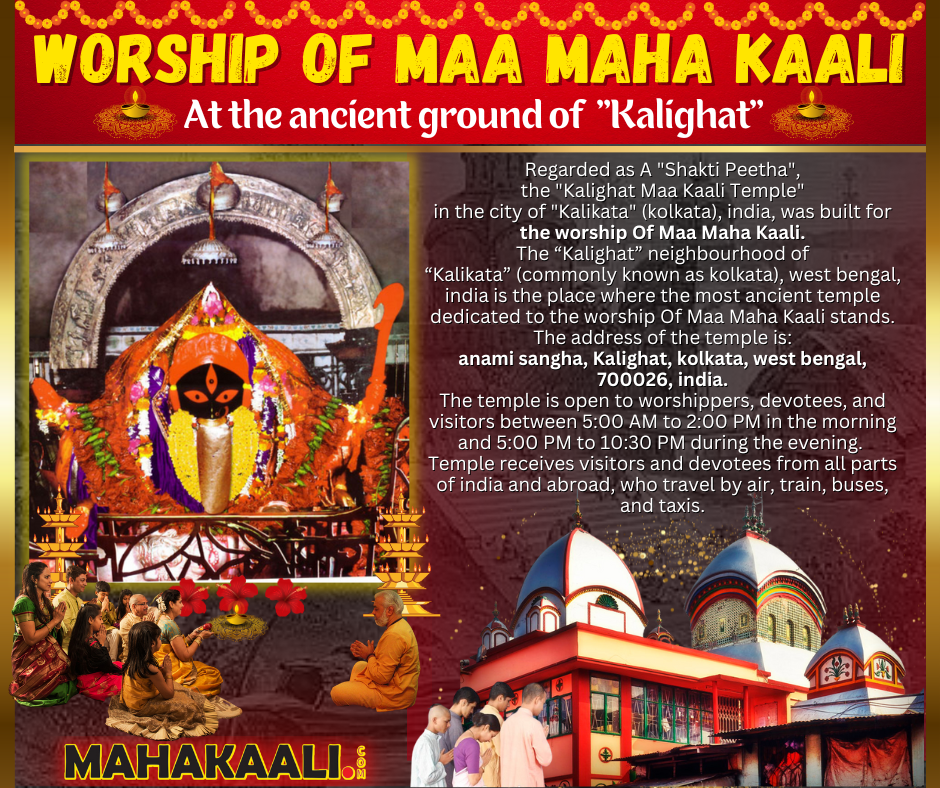
1. “Kalighat Maa Kaali Temple” dedicated to the worship Of Maa Maha Kaali
Worship of Maa Maha Kaali At the ancient ground of “Kalighat”
The “Kalighat Maa Kaali Temple” is also regarded as A “Shakti Peetha”. “Shakti Peetha” Or The Divine Seats Of The Divine Mother Maa Aadi ParaShakti Are Revered As The Holy Sites on earth Where The Various Parts Of Maa Sati’s Holy Body are said to Have Fallen during lord shiva’s rudra tandava.
According to popular legend, a brahmin named atma ram found a human toe shaped stone structure in the bhagirathi river and later in a dream he was Told that the stone he found Was Maa Sati’s Fallen Right Toe. He was Instructed in his dreams to set up a temple and begin worship.
Location
The “Kalighat” neighbourhood of “Kalikata” (commonly known as kolkata), west bengal, india is the place where the most ancient temple dedicated to the worship Of Maa Maha Kaali stands. Although the present structure is 200 years old, the “Kalighat” temple’s reference has been found in 15th century texts and literature.
The address of the temple is: anami sangha, Kalighat, kolkata, west bengal, 700026, india
The Unique Idol
The Idol for the worship Of Maa Maha Kaali In the “Kalighat Maa Kaali Temple” Is Depicted On A Black Coloured Stone With Three Red Eyes, A Long Protruding Golden Tongue, And Four Hands. The Hands Of Maa Maha Kaali Are Depicted Holding A Scimitar Symbolizing Divine Knowledge And a severed head of the demon king shumbha symbolizing the human ego Slayed By The Scimitar Of Divine Knowledge. This Depiction Imparts The Wisdom That only with deeply sincere worship Of Maa Maha Kaali can devotees be Blessed With Divine Knowledge That Eventually Leads To the destruction of ego And Guides Towards spiritual awakening.
This Unique Idol for the worship Of Maa Maha Kaali Resides Only In the “Kalighat Maa Kaali Temple”. Most other temples have Idols In The Anthropomorphic Depiction Of Maa Maha Kaali With Ten Or Four Arms, Standing Atop The Supine Body Of Lord Shiva. This difference is what makes the “Kalighat” temple a special place for the worshippers Of Maa Maha Kaali not only in the city of “Kalikata” (kolkata) but also globally.
Visiting hours and aarti timings
The presence of the temple for the worship Of Maa Maha Kaali has turned “Kalighat” into a historical, symbolic and cultural site in the city. The temple is open to worshippers, devotees, and visitors between 5:00 AM to 2:00 PM in the morning and 5:00 PM to 10:30 PM during the evening.
In addition, the mongal aarti in the temple is done every day at 4 AM in the morning while the daily worship or the nitya puja is done between 5:30 to 7:00 AM as per the norms of the temple. Subsequently, the sandhya aarti starts from 6:30 PM in the evening and ends by 7:00 PM. There is no entry fee to enter the temple.
How to visit the temple
“Kalighat Maa Kaali Temple” is regularly visited by devotees from all parts of india and abroad.
The various modes of Transportation:
Travelers outside india
By air: the temple can be reached by air. The airport nearest to the temple is the netaji subhash chandra bose international airport. The temple is located at around 25 kilometres from the airport and takes 50 mins to an hour to reach.
Travelers from other parts of india
By train: Howrah junction is the nearest railway station that is connected to all major cities in india via rail network. One may either hire a cab or travel by local or mini bus to reach the temple.
The nearest metro station to The “Kalighat Maa Kali Temple” is Kalighat station from the south exit and jatin das park metro from northern exit.
Travelers inside kolkata
By bus: Any buses that go towards south kolkata would take visitors through the Shyama Prasad Mukherjee Road, which is off the temple road. The bus will stop at the Kalighat bus station from where visitors can walk down the temple road towards the temple.
Link to google map of “Kalighat Maa Kaali Temple”:https://www.google.com/maps/place/Kalighat+mandir/@22.5202404,88.3420364,15z/data=!4m6!3m5!1s0x3a0277077ad483ab:0x33b66c43ff5d3a8!8m2!3d22.5202404!4d88.3420364!16s%2Fm%2F03cnb4k?entry=ttu
References
https://kalighatkalitemple.com/article/id/230/history
https://www.socresonline.org.uk/10/1/4.html
https://kolkatatourism.travel/kalighat-kali-temple-kolkata
https://www.trendingnearme.com/story/ultimate-guide-to-visiting-kalighat-kali-temple-in-kolkata/
https://kolkatatourism.travel/kalighat-kali-temple-kolkata
Ultimate Guide to Visiting Kalighat Kali Temple in Kolkata
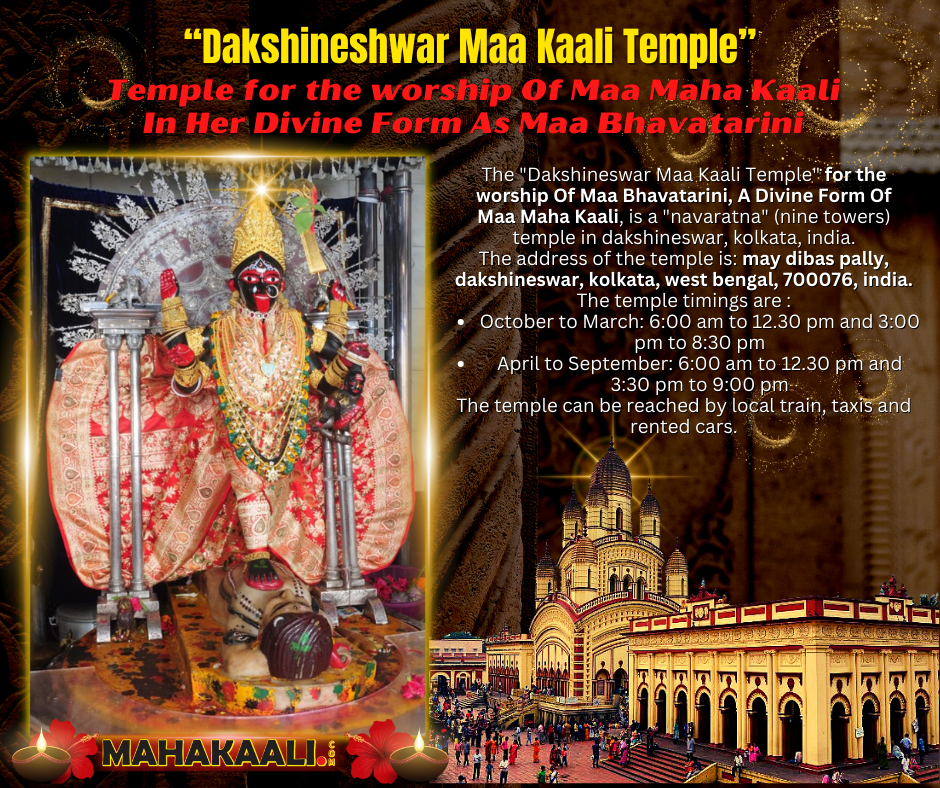
2. “Dakshineshwar Maa Kaali Temple”
Temple for the worship Of Maa Maha Kaali In Her Divine Form As Maa Bhavatarini
Maa Maha Kaali As Maa Bhavatarini Is The Redeemer Of the universe Who Causes the jiva to cross the ocean of samsara.
Location
The “Dakshineswar Kaali Temple” Dedicated To Maa Bhavatarini, A Divine Form Of Maa Maha Kaali, is a “navaratna” (nine towers) Temple in dakshineswar, “Kalikata” (kolkata), india.
The temple is located 13 km away from kolkata and 19 km from howrah.
The address of the “Dakshineswar Maa Kaali Temple” in “Kalikata” (kolkata) is: may dibas pally, dakshineswar, kolkata, west bengal, 700076, india.
Historical background
The Temple was built in 1855 by rani rashmoni a devotee Of Maa Maha Kaali. According to traditional accounts, the night before rani rashmoni’s pilgrimage to banaras, Maa Maha Kaali Appeared In her dream and reportedly Said:
“𝘛𝘩𝘦𝘳𝘦 𝘪𝘴 𝘯𝘰 𝘯𝘦𝘦𝘥 𝘵𝘰 𝘨𝘰 𝘵𝘰 𝘣𝘢𝘯𝘢𝘳𝘢𝘴. 𝘐𝘯𝘴𝘵𝘢𝘭𝘭 𝘔𝘺 𝘚𝘵𝘢𝘵𝘶𝘦 𝘐𝘯 𝘢 𝘣𝘦𝘢𝘶𝘵𝘪𝘧𝘶𝘭 𝘵𝘦𝘮𝘱𝘭𝘦 𝘰𝘯 𝘵𝘩𝘦 𝘣𝘢𝘯𝘬𝘴 𝘰𝘧 𝘵𝘩𝘦 𝘨𝘢𝘯𝘨𝘦𝘴 𝘳𝘪𝘷𝘦𝘳 𝘢𝘯𝘥 𝘢𝘳𝘳𝘢𝘯𝘨𝘦 𝘧𝘰𝘳 𝘔𝘺 𝘸𝘰𝘳𝘴𝘩𝘪𝘱 𝘵𝘩𝘦𝘳𝘦. 𝘛𝘩𝘦𝘯 𝘐 𝘴𝘩𝘢𝘭𝘭 𝘔𝘢𝘯𝘪𝘧𝘦𝘴𝘵 𝘔𝘺𝘴𝘦𝘭𝘧 𝘐𝘯 𝘛𝘩𝘦 𝘐𝘮𝘢𝘨𝘦 𝘈𝘯𝘥 𝘈𝘤𝘤𝘦𝘱𝘵 𝘸𝘰𝘳𝘴𝘩𝘪𝘱 𝘢𝘵 𝘵𝘩𝘢𝘵 𝘱𝘭𝘢𝘤𝘦.”
On 31st may, 1855, on the auspicious occasion of “snana yatra” (a bathing festival Of Deities), The Idol Of Maa Maha Kaali As Maa Bhavatarini Was installed amid great festivities. Within a year, shri ramakrishna paramahansa, a spiritual leader of 19th century bengal and a most ardent devotee Of Maa Maha Kaali, became the priest at The Temple. In the subsequent thirty years, he instilled the seed of change in the socio-religious condition of bengal, earning an immense reputation for The “Dakshineswar Maa Kaali Temple”. The Temple is thronged by millions of devotees and admired for its peaceful ambiance, irrespective of religion and castes.
Visiting Hours
The temple remains open all year round for worshippers and visitors. The temple timings are as follows:
October to March: 6:00 am to 12.30 pm and 3:00 pm to 8:30 pm
April to September: 6:00 am to 12.30 pm and 3:30 pm to 9:00 pm
The temple has no entry free.
How to visit the temple
Dakshineshwar can be reached by the local train that goes to dankuni from sealdah and stops at dakshineshwar station from where the temple is at a walking distance.
Yellow taxis or rental cars from either kolkata or howrah can also be hired to reach the temple. Dakshineshwar is an hours’ drive from howrah and a 30- 40 mins drive from kolkata airport.
Link to the google map of “Dakshineshwar Maa Kaali Temple”:
References
https://www.dakshineswarkalitemple.org/
https://kolkatatourism.travel/dakshineswar-kali-temple-kolkata
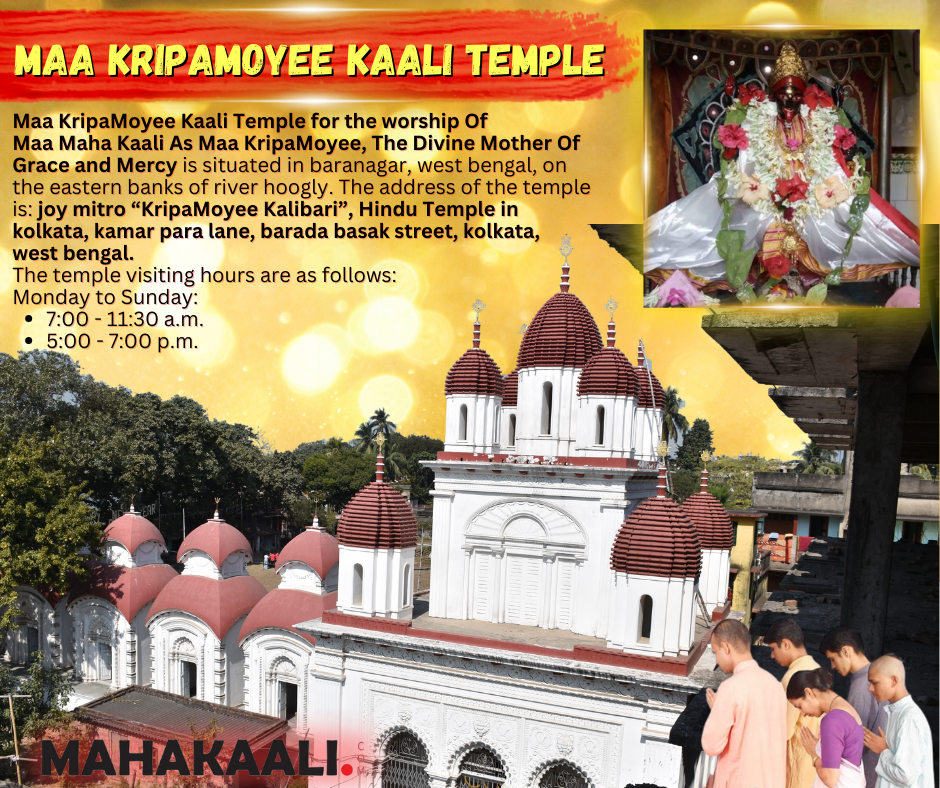
3. Maa KripaMoyee Kaali Temple
Maa KripaMoyee Kaali Temple is also famously known as joy mitro “KaaliBari”. In the temple, Maa Maha Kaali Is Worshiped As Maa KripaMoyee, The Divine Mother Of Grace And Mercy.
Location
Maa KripaMoyee Kaali Temple is situated in baranagar, west bengal, on the eastern banks of river hoogly. The address of the temple is:
joy mitro “KripaMoyee Kalibari”, Hindu Temple in kolkata, kamar para lane, barada basak street, kolkata, west bengal
Historical background
The temple was built in the year 1848 by a famous zamindar by the name of jayaram mitro who was a dedicated devotee Of Maa Maha Kaali. The Beautiful Idol for the worship Of Maa KripaMoyee Kaali was made of kosthi pathar (touch stone).
Visiting hours
Information about the visiting hours of the temple are as follows:
Monday to Sunday:
- 7:00 – 11:30 a.m.
- 5:00 – 7:00 p.m.
Details regarding the means of transportation for worshippers and visitors could not be found.
However, a google map link for visitors’ reference is as follows: https://www.google.com/maps/place/Joy+Mitra+Kripamoyee+Kalibari/@22.6371544,88.3603121,17z/data=!3m1!4b1!4m6!3m5!1s0x39f89d0a9e8302d9:0x3cd784f715cbdf74!8m2!3d22.6371544!4d88.362887!16s%2Fm%2F0h5517l?entry=ttu
References
https://www.bharattemples.com/kripamayee-kali-temple-baranagar/
https://kinjalbose.wordpress.com/2018/10/07/joy-mitra-kali-bari-baranagar/
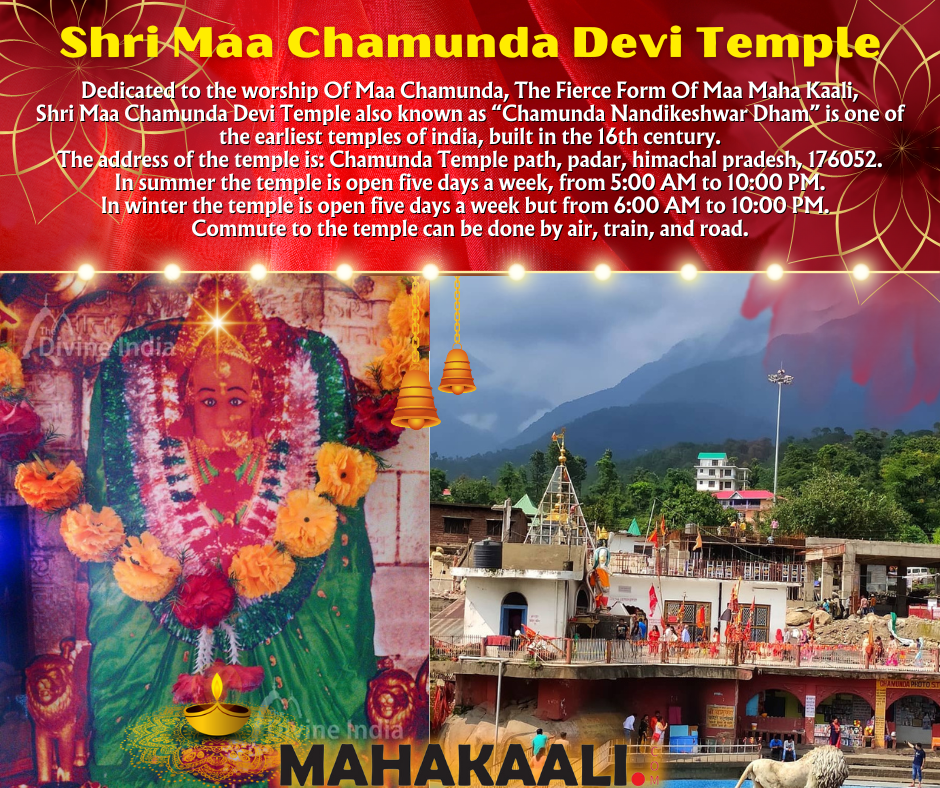
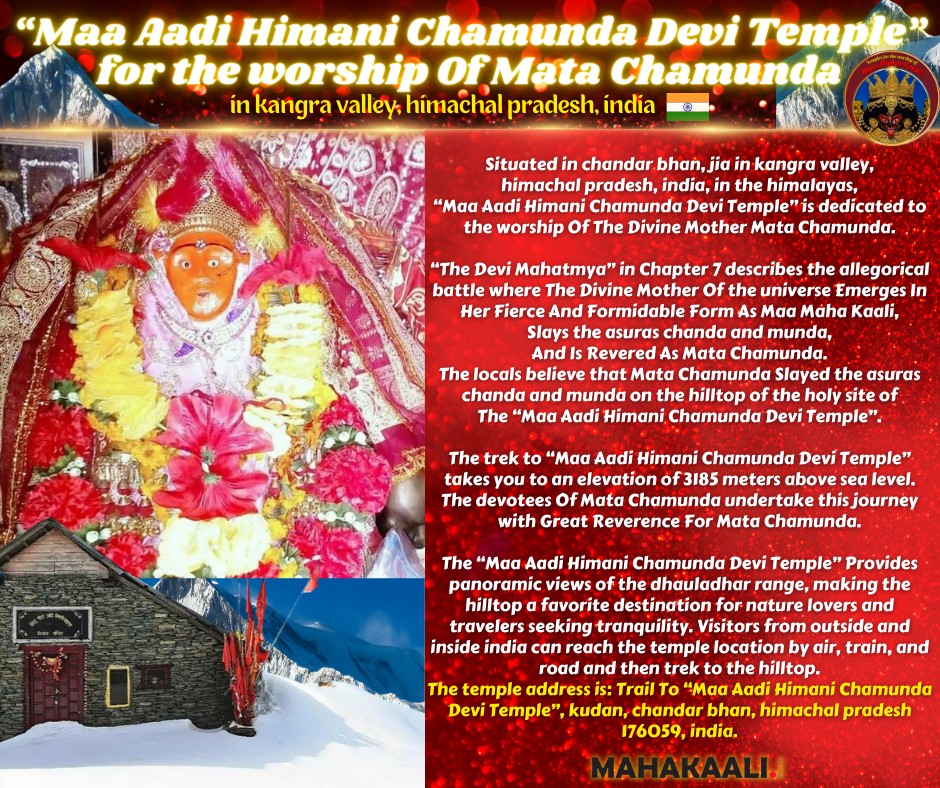
4. Shri Maa Chamunda Devi Temple
Shri Maa Chamunda Devi Temple also known as “Chamunda Nandikeshwar Dham” is one of the earliest temples of india, built in the 16th century.
Location
Shri Maa Chamunda Devi Temple is dedicated to the worship Of Maa Chamunda, The Fierce Form Of Maa Maha Kaali. The temple is located 19 km away from palampur town in dharamshala tehsil of kangra district of the northern indian state of himachal pradesh.
The address of the temple is as follows:
- Chamunda Temple path, dadar, himachal pradesh, 176052.
Historical background
The temple is ancient and has a lot of spiritual legends attached to it. Around four centuries ago, a king and a priest sought Permission From The Divine Mother to relocate the temple to a more favorable location. In response, The Divine Mother Appeared In the priest’s dreams, Instructing him to excavate a specific area of land. To their astonishment, the priest discovered An Ancient Idol Of Maa Chamunda Devi At that very spot. The Idol Was Subsequently Consecrated In the same location And Has Been Venerated there ever since.
Intriguingly however, when The Idol was found and attempts were being made to remove The Idol, the king ordered laborers to do so, but all their efforts proved futile. Later, The Divine Mother Reappeared In the priest’s dreams, And Mentioned that the laborers were unable to remove The Idol because they regarded The Idol as ordinary when It Actually Held Great Significance. The Divine Mother Instructed the priest to rise early in the morning, purify himself through a bath, don sacred attire, and pay Due Reverence To The Idol. Only then, the priest was told, would he be able to relocate The Idol, a feat that had eluded all others. The following day, the priest shared this remarkable story with everyone, attributing the events To The Divine Mother’s Benevolence And Power, and finally gained success in removing The Idol.
Shri Maa Chamunda Devi Temple timings
The temple has different timings for summer and winter. In summer the temple is open five days a week, from 5:00 AM to 10:00 PM. In winter the temple is open five days a week but from 6:00 AM to 10:00 PM.
Aarti timings:
In this temple, aarti is performed two times a day. In winter, the morning aarti happens at 8:00 AM and evening aarti at 6:00 PM. In summer however, the morning aarti happens at 8:00 AM and evening aarti at 8:00 PM.
During the hours of aarti, the pilgrims are not allowed to see The Idol.
How to reach the temple
There are different transport facilities available to reach Shri Maa Chamunda Devi Temple.
- By air: Gaggal is the nearest airport available. This is connected through indian airlines flights with new delhi and chandigarh.
- By train: The nearest railway station available is palampur. Trains are considered safer and more affordable.
- By road: The major towns like dharmashala, palampur and pathankot have many buses, autos, and cabs which lead to the temple.
A google map link for visitors’ reference is as follows:
References
https://www.thedivineindia.com/chamunda-devi-temple/5868
https://devotionalyatra.com/chamunda-devi-temple-timings/
https://timesofindia.indiatimes.com/travel/palampur/chamunda-devi/ps49845050.cms
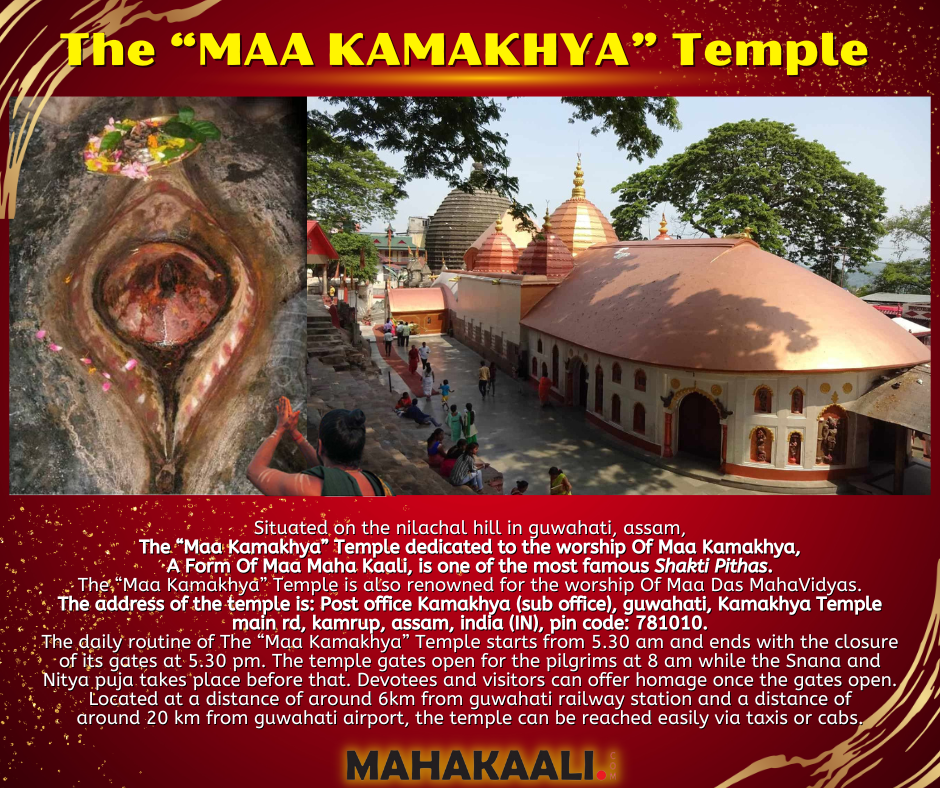
5. The “Maa Kamakhya” Temple
Situated on the nilachal hill in guwahati, assam, The “Maa Kamakhya” Temple dedicated to the worship Of Maa Kamakhya, A Form Of Maa Maha Kaali, is one of the most famous Shakti Pithas Among The Fifty One Shakti Pithas. The “Maa Kamakhya” Temple is also renowned for the worship Of Maa Das MahaVidyas.
At The “Maa Kamakhya” Temple, the innermost sanctum, known as the garbhagṛha, is situated in an underground cave. Within this cave, there exists a stone surface that slopes down on both sides, eventually converging into a yoni-shaped depression that’s about ten inches deep. This depression is constantly filled with water from a perennial underground spring. It is This Yoni-Shaped Hollow That Is Venerated As The Most Sacred Abode Of The Divine Mother And worshipped As The Symbol Of Maa Kamakhya, The Yielder Of all desires And The Giver Of salvation.
Though the present temple was built by koch kings, it is evident from the scattered sculptured stone pieces that there were old temple constructions here in pre koch-period. The carving on these slabs indicate that they probably belong to the seventh-eighth century.
Location
“Maa Kamakhya” Temple is located in the nilachal hill, town of tilla, in western part of the district of guwahati, in the state of assam, in india.
The address of the temple is: Post office Kamakhya (sub office), guwahati, Kamakhya Temple main rd, kamrup, assam, india (IN), pin code: 781010.
Legends Of The “Maa Kamakhya” Temple
Shakti Pithas Are The Divine Seats Of The Divine Mother Maa Aadi ParaShakti, Which Are Revered As The Holy Sites on earth Where The Various Parts Of Maa Sati’s Holy Body are said to Have Fallen during lord shiva’s rudra tandava. The “Maa Kamakhya” Temple is where The Yoni Of Maa Sati’s Body is said to Have Fallen, which is why, there is the worship Of The Yoni At this temple.
In another legend found in The “Kalika” Purana, The “Maa Kamakhya” Temple is the centre of love and romance as this is where Lord Shiva And Maa Sati Experienced The Bliss Of Divine Union.
The earliest written mentions Of Maa Kamakhya can be traced back to inscriptions on the tezpur plates and the parbatiya plates during the reign of vanamalavarmadeva in the mid-ninth century. These inscriptions describe The Presence Of Lord KamEshvara And Maa MahaGauri Atop a hill known as kamakutagiri.
According to another legend, The Holy “Name” Of Maa Kamakhya Signifies That She Is The Divine Mother Venerated And worshipped by lord kama. As the story goes, the god of love, lord kama had sought out Maa Shakti’s Womb And Yoni after having lost virility to a curse, and had regained his potency By The Blessings Of Maa Kamakhya.
Visiting hours
The temple is accessible throughout the year, with each season offering its unique charm. Nevertheless, a significant number of individuals prefer to explore the temple during the rainy season of ashaar to partake in the Ambubachi Mela.
The daily routine of The “Maa Kamakhya” Temple starts from 5.30 am and ends with the closure of its gates at 5.30 pm. The temple gates open for the pilgrims at 8 am while the Snana and Nitya puja takes place before that. The devotees and visitors can offer homage once the gates open.
Daily Events
5:30 AM: Snana of the Pithasthana.
6:00 AM: Nitya puja.
8:00 AM: Temple open for devotees.
1:00 PM: Temple closed for offering food To The Divine Mother, followed by food distribution to devotees.
2:30 PM: Temple reopens for the devotees.
5:30 PM: Aarati Of The Divine Mother followed by the closing of the temple for the night.
How to reach the temple
Located at a distance of around 6km from guwahati railway station and a distance of around 20 km from guwahati airport can be reached easily via taxis or cabs available for hire.
If you are a trekking enthusiast then this destination is definitely an attractive one as you can choose to reach the temple situated on the hilltop by climbing up the nilachal hill.
Link to google map: https://www.google.com/maps/contrib/114193077983814492514/photos/@26.1664139,91.7051512,17z/data=!3m1!4b1!4m3!8m2!3m1!1e1?entry=ttu
References
Shin, J.-E. (2010). Yoni, Yogins and Mahavidyas: Feminine Divinities from Early Medieval Kamarupa to Medieval Koch Behar. Studies in History (Sahibabad), 26(1), 1–29. https://doi.org/10.1177/025764301002600101
https://www.templepurohit.com/hindu-temples/Goddess-Kali/
https://kamrupmetro.assam.gov.in/tourist-place-detail/218
https://www.thebetterindia.com/114044/the-legend-of-kamakhya-temple-assam-bleeding-goddess-assam/
https://pincode.net.in/kamakhya-temple-main-rd-guwahati-kamrup-assam-781010
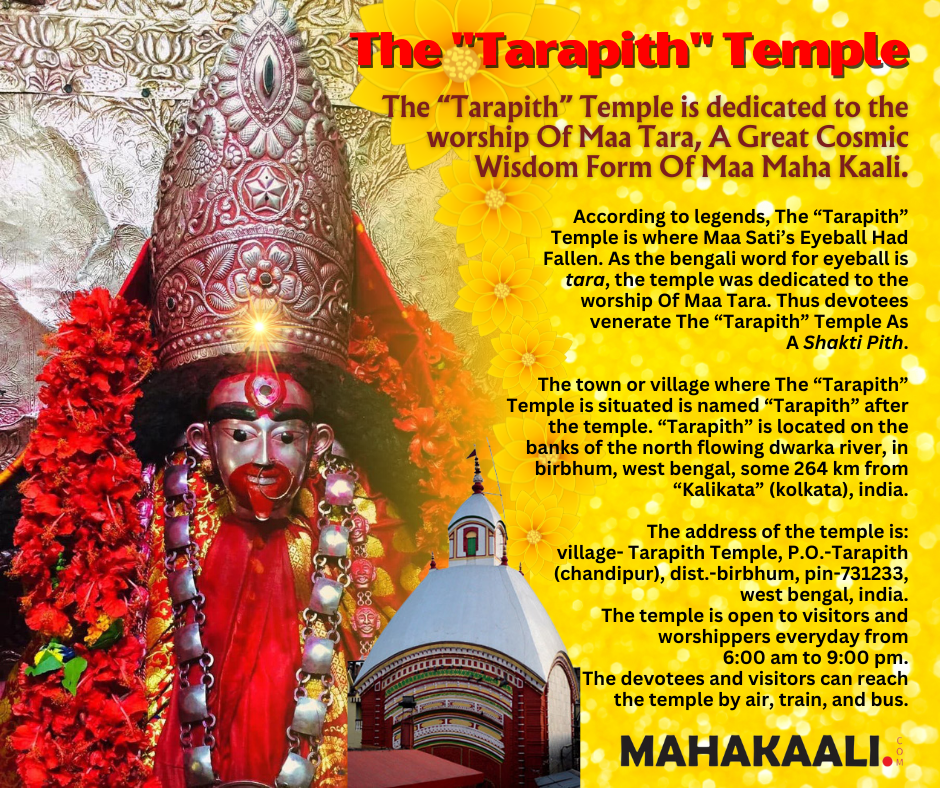
6. The “Tarapith” Temple
The “Tarapith” Temple is dedicated to the worship Of Maa Tara, A Great Cosmic Wisdom Form Of Maa Maha Kaali. According to legends, The “Tarapith” Temple is where Maa Sati’s Eyeball Had Fallen. As the bengali word for eyeball is tara, the temple was dedicated to the worship Of Maa Tara. Thus devotees venerate The “Tarapith” Temple As A Shakti Pith, A Divine Seat Of The Divine Mother Maa Aadi ParaShakti. Shakti Piths Are Revered As The Holy Sites on earth Where The Various Parts Of Maa Sati’s Holy Body are said to Have Fallen during lord shiva’s rudra tandava.
The “Tarapith” Temple is also quite renowned for being one of the few temples where tantric rituals are practiced.
Origin story
The origin of The “Tarapith” Temple can be traced back to vashishta’s quest to master the tantric arts. Despite his prolonged efforts, he failed to achieve success. Seeking guidance, he approached buddha, who had a vision that “Tarapith” was the ideal place to worship Maa Tara. Following buddha’s advice, vashishtha came to “Tarapith” and performed a left-handed tantric ritual, incorporating the use of the 5 forbidden elements (panchamakara). Impressed by his devotion, The Divine Mother Manifested As Maa Tara Nursing Lord Shiva At Her Breast And Then Transformed Into Stone. Since then, The Depiction Of Maa Tara In Her Maternal Form, Nursing Lord Shiva, Has Been Venerated At “Tarapith”.
After the original temple had suffered some damage, a new temple with eight roofs was constructed in 1225 by jagannath ray from the village of mallarpur. The temple’s main gate features intricately carved Statues Of Goddess Durga And Her Entire Family. Additionally, depictions of the kurukshetra war from the mahabharata are showcased on the left, while stories from the ramayana are depicted on the right.
The Two Idols At The ”Tarapith” Temple
Inside the sanctum, There Are Two Idols Of Maa Tara. The First Is A Stone Image Portraying Maa Tara As A Mother Nursing Lord Shiva, but It Is Concealed By A Three-Foot-Tall Metal Idol That Is Typically Visible To the worshippers. The Stone Statue Depicts Maa Tara In Her Fierce Form, With Four Arms, Flowing Hair, An Extended Tongue, And Adorned With A Garland Of skulls. The Outer Metal Idol Is Adorned With a silk sari, marigold garlands, and sheltered by a silver umbrella Above The Head.
Only after the evening aarti ceremony do the devotees have the opportunity to catch a glimpse Of The Original Stone Idol.
Location
The town or village where The “Tarapith” Temple is situated is named “Tarapith” after the temple. “Tarapith” is located on the banks of the north flowing dwarka river, in birbhum, west bengal, some 264 km from “Kalikata” (kolkata), india.
The address of the temple is: village- Tarapith Temple, P.O.-Tarapith (Chandipur), dist.-birbhum, pin-731233, west bengal, india.
Visiting hours
The temple is open to visitors and worshippers everyday of every season from 6:00 am to 9:00 pm.
Visitors have to be careful about not taking photos as photography at the temple is not allowed.
How to reach the temple
The devotees and visitors have the following travel options:
- By air: The nearest airport is at kolkata, at a distance of 225 km from “Tarapith”. One can avail taxi services from airport to “Tarapith”. “Tarapith” is easily accessible from kolkata, delhi, mumbai and other major airports.
- By bus: The state owned buses connect “Tarapith” with to esplanade/dharamtalla bus stand of kolkata or with the neighboring cities.
- By train: The nearest railway station is rampurhat, at a distance of about 9 km from “Tarapith”. Taxi services from railway station to “Tarapith” are available. Rampurhat is linked with howrah and sealdah.
A link to the google map is as follows: https://www.google.com/maps/d/viewer?mid=1jh22I_ihxX_s00QhpKraAxVOJEg&hl=en_US&ll=24.08262803049236%2C88.02132824629145&z=13
References
https://www.templepurohit.com/hindu-temple/tarapith-temple-west-bengal/
https://thebengalitoday.com/2021/04/tarapith-temple.html
https://timesofindia.indiatimes.com/topic/tarapith-kali-temple/news

7. The “Kalika Mata” Temple, pavagadh
The “Kalika Mata” Temple, pavagadh is revered as a “Shakti Peetha/Pitha” As The Holy Toe Of Maa Sati Is said to have Fallen here, and the hill is visualized as A Symbol Of The Toe.
Before The Idol for the worship Of Kalika Mata Was Invoked And Installed On top of the pavagadh hill, gujarat by maharishi vishvamitra, The Divine Mother Maa Maha Kaali As Kalika Mata Was worshipped by the local bhil and koli people.
Location
The ancient temple for the worship Of Maa Maha Kaali As Kalika Mata is located at an elevation of 762 meters above sea level on the peak of pavagadh hill, in the indian state of gujarat making it the oldest temple in the region with origins dating back to the 10th and 11th centuries.
Devotees have been making pilgrimages to this sacred site long before the surrounding champaner evolved into a prominent city, and this tradition has endured for centuries, persisting even to the present day despite champaner’s decline. The temple complex is now part of the champaner-pavagadh archaeological park, a UNESCO world heritage site.
The address of the temple is: The “Kalika Mata” Temple, pavagadh hill, panchmahal, gujarat, india.
An intriguing legend
According to historical records, jaisinh, a king of the patai dynasty, ruled the champaner kingdom at the foot of the pavagadh hill. An intriguing legend about the temple recounts an event during a celebration in worship Of Maa Maha Kaali, when the community arranged a garbha performance. During the festivities, Maa Maha Kaali Was Immensely Pleased With the devotion of Her devotees And Decided To Partake In the dance, Taking On A Physical Form. However, king jaisinh, enchanted By The Mesmerizing Beauty Of The Form Of The Divine Mother, expressed inappropriate desires. Despite being Cautioned By Her, the king continued to throw lustful glances, and acted disrespectfully. This Angered The Divine Mother Greatly, Leading Her To Curse the king, Foretelling a catastrophic decline for his kingdom. Later, the mughal king mahmud begada invaded champaner and defeated the king in battle, and thus the thriving champaner kingdom collapsed due to The Curse Of Maa Maha Kaali.
Visiting hours
The temple welcomes pilgrims round the clock, with its doors open from dawn till late in the evening to cater to visitors at any time.
Temple timings : 5:00 AM to 7:00 PM
Aarti timings
5:00 AM and 6:30 PM
Entry price : None for the temple
Cable car – INR 90 – 120
Pilgrims can find lodging at the machi haveli, a dedicated rest house designed to accommodate them during their visit.
How to reach the temple
Devotees can reach the temple by the following modes of transportation:
- By road: champaner is 45 km from vadodara, accessible by bus or private vehicles. Cars can be hired in vadodara to drive to champaner-pavagadh, which is the best option if you want to combine the journey with other sites like jambughoda.
- By Train: The city lies on the busy mumbai-delhi western railway mainline and is well connected by premium trains like shatabdi and rajdhani.
- By air: Visitors from outside and inside india can reach gujarat airport by covering a flight journey from their places of departure. Domestic flights connect vadodara (BDQ) to major cities in india.
Reaching the temple at the summit involves a roughly 5-kilometer hike along a jungle trail leading to the hill’s peak. Alternatively, there’s a cable car service available from the midway point, which is the furthest point accessible by road that can transport to the summit.
References
https://www.gujarattourism.com/central-zone/panchmahal/pavagadh-hill—kalika-mata-temple.html
https://www.gujaratexpert.com/blog/kali-mata-temple/
https://templeknowledge.com/kalika-mata-temple-pavagadh/
https://www.holidify.com/places/champaner-pavagadh/kalika-mata-temple-sightseeing-4316.html
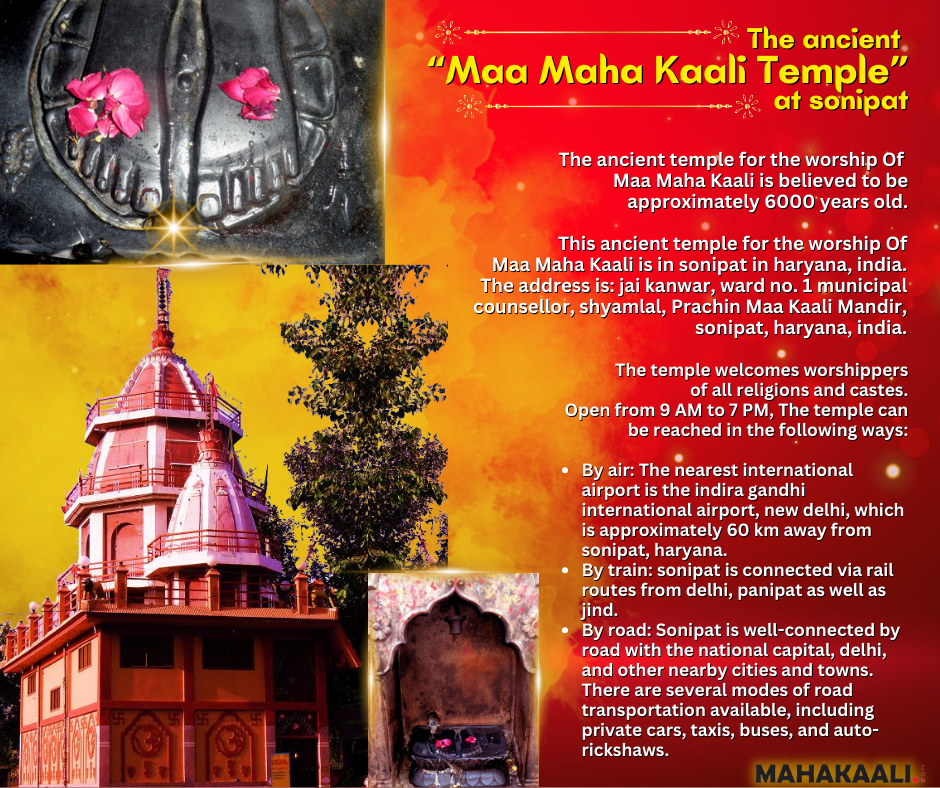
8. The ancient “Maa Maha Kaali Temple” at sonipat
In sonipat, haryana, india, along kami road situated at ram leela ground, there is an ancient temple for the worship Of Maa Maha Kaali, which is believed to be approximately 6000 years old.
The legend of sonipat
According to legend, prior to the kurukshetra battle in the great epic mahabharata, the pandavas sought Blessings From Maa Maha Kaali Through prayers at sonipat. Additionally, the pandavas are believed to have built a well near the temple, known as the pandva’s well.
The everlasting flame
Inside this ancient “Maa Maha Kaali Temple” at sonipat, an everlasting flame continuously burns. There’s a belief that anyone who devoutly prays here for 40 days with a pure and sincere heart will have their wishes Granted By The Divine Mother.
Grateful devotees, upon the fulfillment of their desires, present garlands of lemons To Maa Maha Kaali.
Location
This ancient temple for the worship Of Maa Maha Kaali is located in sonipat in haryana, india. The address of the temple is: jai kanwar, ward no. 1 municipal counsellor, shyamlal, Prachin Maa Kaali Mandir, sonipat, haryana, india.
Visiting hours
The temple welcomes worshippers of all religions and castes. The temple is open from 9:00 AM to 7:00 PM.
How to reach the temple
The temple can be reached in the following ways:
By air: The nearest international airport is the indira gandhi international airport, new delhi, which is approximately 60 km away from sonipat, haryana.
By train: sonipat is connected via rail routes from delhi, panipat as well as jind.
By road: Sonipat is well-connected by road with the national capital, delhi, and other nearby cities and towns. There are several modes of road transportation available, including private cars, taxis, buses, and auto-rickshaws. Major highways and roads connect sonipat to various parts of haryana and neighboring states. The most common route from delhi to sonipat is via NH44 or NH9, both of which provide good road connectivity.
References
https://sonipat.gov.in/tourist-place/old-maa-kaali-temple/
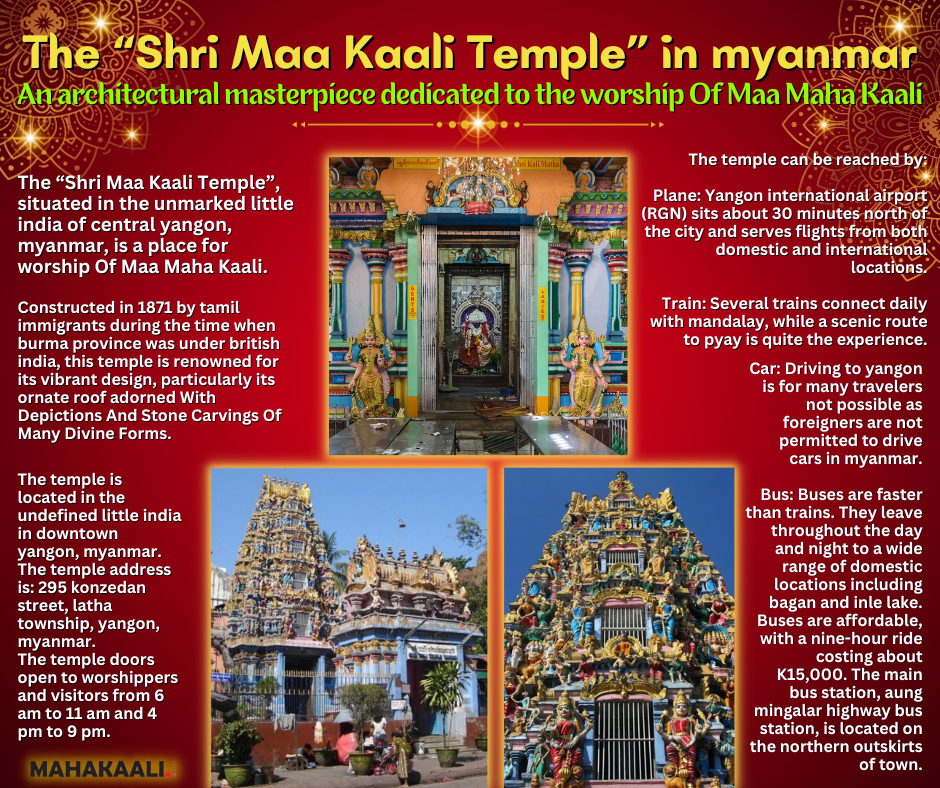
9. The “Shri Maa Kaali Temple” in myanmar
An architectural masterpiece dedicated to the worship Of Maa Maha Kaali
The “Shri Maa Kaali Temple”, situated in the unmarked little india of central yangon, myanmar, is a place for worship Of Maa Maha Kaali. Constructed in 1871 by tamil immigrants during the time when burma province was under british india, this temple is renowned for its vibrant design, particularly its ornate roof adorned With Depictions And Stone Carvings Of Many Divine Forms. The local indian community is responsible for the upkeep and maintenance of this temple.
Unique architecture
The “Shri Maa Kaali Temple” stands out as a lavishly adorned temple, showcasing Remarkable Stone Sculptures And Carvings Portraying Many Divine Forms Throughout its vibrant roof. The temple’s vivid outward appearance, notably its distinct tower (gopuram), is easily identifiable. Abundantly adorned With Sculptures And Carvings Depicting narratives from great ancient indian mythology, it truly captures attention.
Location
The “Shri Maa Kaali Temple” is located in the undefined little india in downtown yangon, myanmar.
The temple address is: 295 konzedan street, latha township, yangon, myanmar.
Visiting hours
The temple doors open to worshippers and visitors from 6 am to 11 am and 4 pm to 9 pm. All worshipper and visitors are advised to leave their shoes outside the temple.
How to reach the temple
The “Shri Maa Kaali Temple”, yangon, myanmar can be reached in the following ways:
Plane: Yangon international airport (RGN) sits about 30 minutes north of the city and serves flights from both domestic and international locations. Taxis to the airport cost approximately K8000.
Train: Trains are a popular mode of travel in myanmar, and yangon is no different. Several trains connect daily with mandalay, while a scenic route to pyay is quite the experience. Sleeper fares to mandalay run approximately K48,000 and take nearly 24 hours.
Car: Driving to yangon is for many travelers not possible as foreigners are not permitted to drive cars in myanmar.
Bus: Buses provide a much faster alternative to trains. They leave throughout the day and night to a wide range of domestic locations including bagan and inle lake. Buses are affordable, with a nine-hour ride costing about K15,000. The main bus station, aung mingalar highway bus station, is located on the northern outskirts of town.
References
https://www.yangongui.de/shri-kali-hindu-temple/
https://www.myanmars.net/yangon/sri-kali-temple.html
https://www.templefolks.com/temple-pedia/shri-kali-temple-burma.html
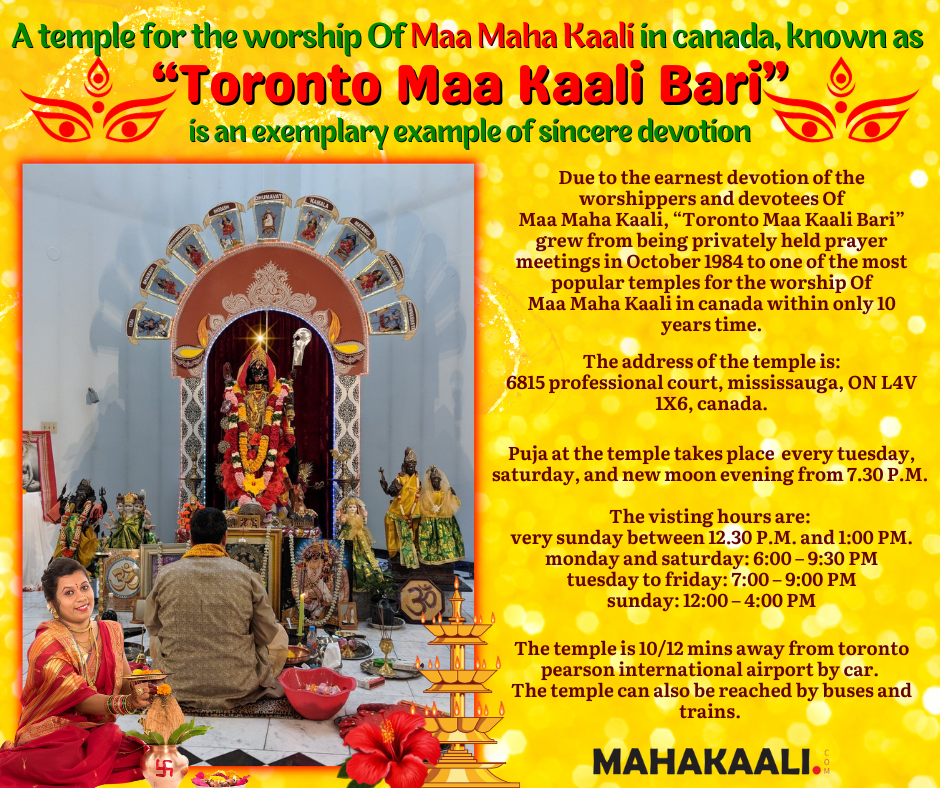
10. A temple for the worship Of Maa Maha Kaali in canada known as “Toronto Maa Kaali Bari” is an exemplary example of sincere devotion
Due to the earnest devotion of the worshippers and devotees Of Maa Maha Kaali, “Toronto Maa Kaali Bari” grew from being privately held prayer meetings in October 1984 to one of the most popular temples for the worship Of Maa Maha Kaali in canada in only 10 years.
History of the temple
In 1984, members of the community initiated prayer meetings in private homes to worship and meditate Upon Maa Maha Kaali. These gatherings grew, prompting the need for larger public spaces. The charitable organization “Toronto Maa Kaali Bari” was registered in 1985 and acquired a property in brampton in 1986, transforming a house into a mandir dedicated to the worship Of Maa Maha Kaali. With overwhelming community support, the mortgage was paid off by 1990. Due to zoning challenges and lack of public transport, a new plot was purchased in mississauga in 1995. Construction for a new temple began in 1997, and the move was completed in 1998. A specially sculpted Murti For the worship Of Maa Maha Kaali was consecrated in 1998, marking the continuation of regular puja, prayers, and community activities at the present location.
The Idol For the worship Of Maa Maha Kaali
The Idol For the worship Of Maa Maha Kaali, crafted from blue granite and white marble, was made in india and transported to toronto in 1993. On october 19, 1998, during diwali night, The Idol was officially consecrated at the new temple. From that point onwards, various rituals, prayers, and other activities have been regularly held at the current place of worship.
Location
“Toronto Maa Kaali Bari” situated at the heart of mississauga is a sanctuary for all worshippers and devotees. The address of the temple is: 6815 professional court, mississauga, ON L4V 1X6, canada.
Visiting hours
The temple is open for puja and prayer on designated days as per the following schedule:
Puja –
Every tuesday, saturday, new moon evening – starts from 7.30 P.M.
Every sunday – starts between 12.30 P.M. and 1:00 PM
Opening hours –
monday and saturday: 6:00 – 9:30 PM
tuesday to friday: 7:00 – 9:00 PM
sunday: 12:00 – 4:00 PM
How to reach the temple
Bus stations near “Toronto Maa Kaali Bari” in mississauga:
- malton go station acrd,1 min walk
- goreway dr at 6870 goreway dr, 7 min walk
- derry rd at professional crt, 8 min walk
- goreway dr at nashua dr, 21 min walk
- northwest dr at 6757 northwest dr, 34 min walk
Bus lines to “Toronto Maa Kaali Bari” in mississauga:
- 30, westbound
- 16, southbound
- 14, torbram
- 18, mclaughlin-derry
- 42, derry
- 107, southbound
- 24, southbound
Train stations near “Toronto Maa Kaali Bari” in mississauga:
- up express pearson airport, 24 min walk
- malton, 43 min walk
Airport nearest to “Toronto Maa Kaali Bari” in mississauga:
- toronto pearson international airport (Yyz)
“Toronto Maa Kaali Bari” is 10 to 12 mins away from the airport by car.
Google map of “Toronto Maa Kaali Bari” from toronto pearson international airport: https://www.google.com/maps/dir/Toronto+Pearson+International+Airport+(YYZ),+6301+Silver+Dart+Dr,+Mississauga,+ON+L5P+1B2/Toronto+Kalibari,+6815+Professional+Ct,+Mississauga,+ON+L4V+1X6/@43.6993695,-79.6442359,14z/data=!3m1!4b1!4m14!4m13!1m5!1m1!1s0x882b394ac02dd491:0xb41d5de9c4030ec5!2m2!1d-79.6227299!2d43.6797396!1m5!1m1!1s0x882b3be66ae720ad:0x20c21cb03d3621fb!2m2!1d-79.6298799!2d43.707552!3e0?entry=ttu
For more information, please visit the “Toronto Maa Kaali Bari” website: http://www.KaliBaritoronto.com/
References
http://www.Kalibaritoronto.com/
https://canada247.info/explore/ontario/peel_regional_municipality/mississauga/toronto_kalibari.html
https://www.cylex-canada.ca/company/toronto-kalibari-17207032.html
https://moovitapp.com/index/en/public_transit-Toronto_Kalibari-Toronto_ON-site_7401485-143
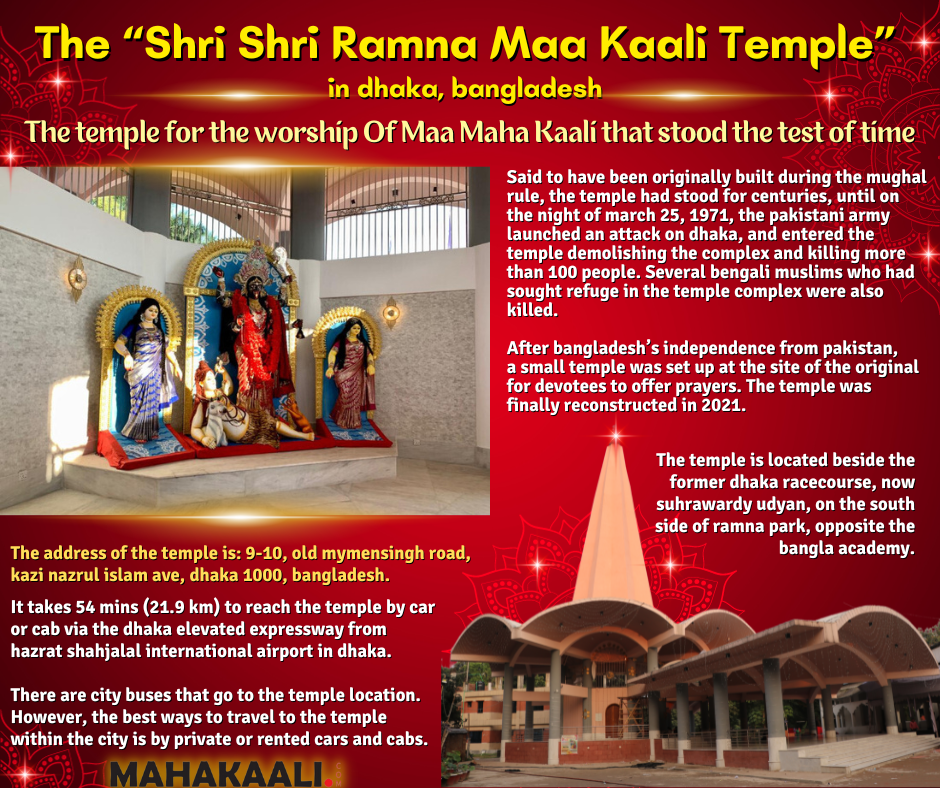
11. The “Shri Shri Ramna Maa Kaali Temple” in dhaka, bangladesh
The temple for the worship Of Maa Maha Kaali that stood the test of time.
History of the temple
The temple is said to have been originally built during the time of the mughal rule. In nepalese folklore, The “Shri Shri Ramna Maa Kaali Temple” was founded by the devotees Of Maa Maha Kaali, who had come to bengal from the himalayas. It is also said that the temple was built by a group of pilgrims who were the followers of sankaracharya.
Although the temple had stood for centuries, it was largely developed in the early 20th century. However, on the night of march 25, 1971, the pakistani army launched an attack on dhaka in order to suppress a bengali liberation movement in what was then east pakistan. During the attack the pakistan army entered The “Shri Shri Ramna Maa Kaali Temple”, demolished the temple complex and killed more than 100 people. Several bengali muslims who had sought refuge in the temple complex were also killed.
After bangladesh gained independence from pakistan, a small temple was set up at the site of the original “Shri Shri Ramna Maa Kaali Temple” for devotees to offer prayers. A reconstruction of the complex was announced in 2017, and in 2021, the reconstructed temple was inaugurated.
Unique architecture
Although the architectural design of the temple changed over the years, the temple has always had a tall conical spire on the roof.
Location
The temple is located beside the former dhaka racecourse, now suhrawardy udyan. The entire temple complex occupies almost 2.25 acres (9,100 m2) and is on the south side of ramna park, opposite the bangla academy.
The address of the temple is: 9-10, old mymensingh road, kazi nazrul islam ave, dhaka 1000, bangladesh.
How to reach the temple
The temple is open to visitors and worshippers 24 hours of every day. As it is in dhaka, the capital of bangladesh, visitors and devotees visiting from outside the country can take a flight to dhaka and land at the hazrat shahjalal international airport. It takes 54 mins (21.9 km) to reach the temple by car or cab via the dhaka elevated expressway.
There are city buses that go to the temple location. However, the best ways to travel to the temple within the city is by private or rented cars and cabs.
Google map link of the temple from hazrat shahjalal international airport: https://www.google.com/maps/dir/Hazrat+Shahjalal+International+Airport+(DAC),+Airport+-+Dakshinkhan+Road,+Dhaka,+Bangladesh/Shri+Shri+Ramna+Kali+Temple,+9-10,+Old+Mymensingh+Road,+Kazi+Nazrul+Islam+Ave,+Dhaka+1000,+Bangladesh/@23.7985112,90.3205498,12z/data=!3m1!4b1!4m13!4m12!1m5!1m1!1s0x3755c691ba478fbd:0xd1b3f71371eb15ec!2m2!1d90.4029252!2d23.8434344!1m5!1m1!1s0x3755b8eedbe514c7:0x310ae20d1bccfdf7!2m2!1d90.399502!2d23.7312287?entry=ttu
References
https://en.wikipedia.org/wiki/Ramna_Kali_Mandir#:~:text=The%20Ramna%20Kali%20Mandir%20(Bengali,as%20the%20%22Ramna%20Kalibari%22.
https://en.banglapedia.org/index.php/Ramna_Kali_Mandir
https://www.top-rated.online/cities/Dhaka/place/p/5182379/Shri+Shri+Ramna+Kali+Temple
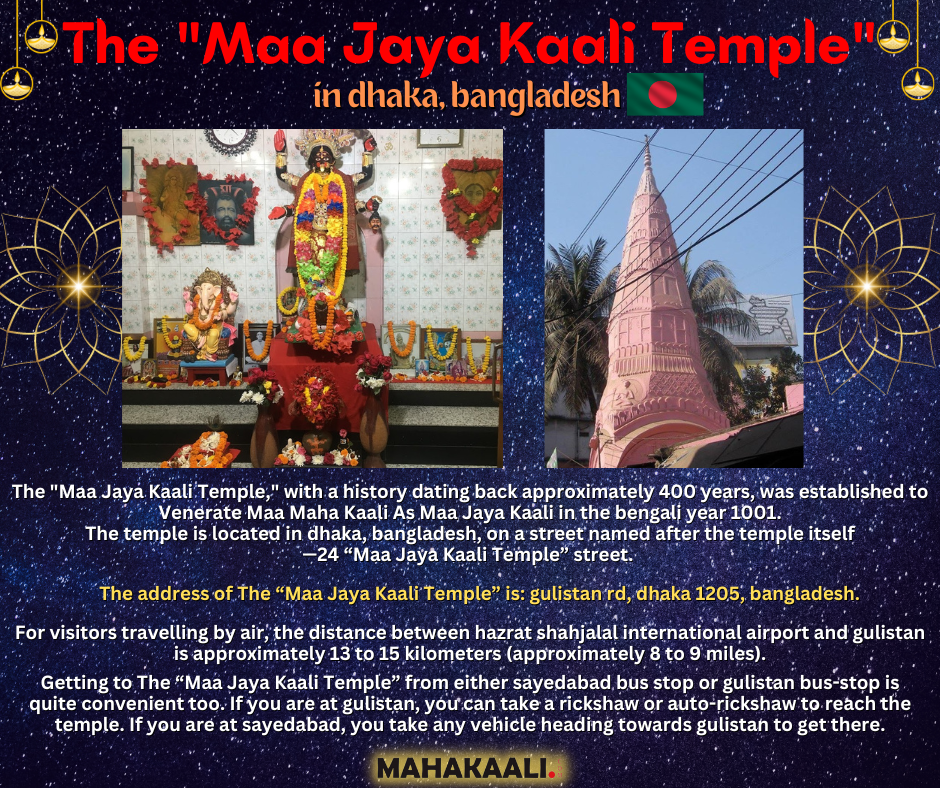
12. The “Maa Jaya Kaali Temple” in dhaka, bangladesh
The “Maa Jaya Kaali Temple”, or mondir as it is called in bengali, is located in dhaka, bangladesh, positioned between thathari bazar and wari. The temple is on a street named after the temple itself—24 “Maa Jaya Kaali Temple” street.
History
The “Maa Jaya Kaali Temple,” with a history dating back approximately 400 years, was established to Venerate Maa Maha Kaali As Maa Jaya Kaali in the bengali year 1001. This sacred place was founded during the reign of the nawabs, orchestrated by dewan tulsi narayan ghosh and nabh narayan ghosh under the guidance of bancharam saint. The temple complex was built to include a shrine for the worship of lord shiva. During that historical era, markets such as nawabpur’s “Maa Jaya Kaali Bazar” and a market south of the “Kaliganj” hut were dedicated to the worship Of Maa Jaya Kaali Devi.
Temple architecture
The architecture of The “Maa Jaya Kaali Temple” includes a dome shaped roof and a square-shaped structure. Although the locals of that area refer to the dome as The “Maa Jaya Kaali Temple”, the dome is the shrine for the worship of lord shiva and the square-shaped structure houses The Idol for the worship Of Maa Jaya Kaali.
Location
The “Maa Jaya Kaali Temple”, is located between thathari bazar and wari in dhaka, bangladesh. The address of The “Maa Jaya Kaali Temple” is: gulistan rd, dhaka 1205, bangladesh.
Visiting hours:
The temple is open to worshippers and visitors every day from 8:00 AM to 10:00 PM.
How to reach the temple
For visitors from outside bangladesh, to get to gulistan from hazrat shahjalal international airport in dhaka, you can follow these steps:
- Taxi or ride-sharing services: The most convenient and common way to travel from the airport to gulistan is by taking a taxi or using ride-sharing services like uber or pathao. There are designated taxi stands outside the airport where you can easily find a taxi to gulistan.
- Airport shuttle service: Check if there are any airport shuttle services available that go to gulistan or nearby areas. These shuttles often have fixed routes and schedules.
- Public bus: You can take a public bus from the airport to gulistan. Public buses typically have fixed routes, so you’ll need to find a bus that goes in the direction of gulistan.
- Rickshaw or CNG auto rickshaw: If you prefer a cheaper option, you can take a rickshaw or CNG (compressed natural gas) auto-rickshaw from the airport to gulistan. Keep in mind that these options are suitable for shorter distances.
- Car rentals: If you’re comfortable with driving in dhaka, you can rent a car from the airport and drive to gulistan. Make sure to have a GPS or a map to navigate the route.
Always confirm the fare and mode of payment (cash or digital) before starting your journey, especially with taxis or ride-sharing services. It’s also a good idea to ask for an estimated fare to gulistan to avoid any misunderstandings.
The distance between hazrat shahjalal international airport and gulistan is approximately 13 to 15 kilometers (approximately 8 to 9 miles) depending on the specific route taken and the starting point within the airport complex. The travel time can vary based on traffic conditions, but it generally takes around 30 minutes to an hour to cover this distance by road, considering typical traffic in dhaka.
Getting to The “Maa Jaya Kaali Temple” from either sayedabad bus stop or gulistan bus-stop is quite convenient too. If you are at gulistan, you can take a rickshaw or auto-rickshaw to reach the temple. If you’re at sayedabad, you can hop on any vehicle heading towards gulistan to get there.
Link of google map of the temple from hazrat shahjalal international airport: https://www.google.com/maps/dir/Hazrat+Shahjalal+International+Airport+(DAC),+Airport+-+Dakshinkhan+Rd,+Dhaka+1229,+Bangladesh/Jai+Kali+Temple,+PCC8%2BHMX,+Gulistan+Rd,+Dhaka+1205,+Bangladesh/@23.7937454,90.3205507,12z/data=!3m1!4b1!4m14!4m13!1m5!1m1!1s0x3755c691ba478fbd:0xd1b3f71371eb15ec!2m2!1d90.4029252!2d23.8434344!1m5!1m1!1s0x3755b856a9246959:0x8248780cfaf2ab9!2m2!1d90.4167201!2d23.7214813!3e0?entry=ttu
References
http://offroadbangladesh.com/places/joy-kali-temple/

13. The “Maa Maha Shakti Temple” at skanda vale ashram, uk
The “Maa Maha Shakti Temple”, also knowns among devotees as The “Maa Maha Kaali Temple” is a temple for the worship Of Maa Maha Kaali at the skanda vale ashram. The skanda vale ashram was established in 1973 by guru sri subramanium, to be a pilgrimage site where individuals from diverse religious backgrounds could come together to serve and worship in unity. The temple was inaugurated in 1991 by guru sri subramanium Under The Direct Guidance Of The Divine Mother, Through Divine Appearances To guruji since 1986.
The Sacred Idol
In the temple Is The Sacred Idol for worship Of Maa Maha Kaali, Standing At A Height Of Six Feet. The Sacred Idol is encircled by shrines dedicated to the worship Of Maa Maha Lakshmi, Maa Maha Saraswati, Mother Mary, and various other shrines for the worship Of The Many Forms Of The Divine Mother.
Location
The skanda vale ashram is situated in a remote, wooded valley, near carmarthen in south west wales – a five hour drive from london, uk.
The address of skanda vale ashram is: the community Of The Many “Names” Of God, skanda vale, llanpumsaint, carmarthen, SA33 6JT, wales, uk
Visiting hours
Visitors can partake in pujas at the temple daily at 06:30 and 18:00, with closure at all other times. The temple has a limited capacity, accommodating up to 50 individuals at a time. During saturdays from may to september, free passes are distributed randomly to ensure everyone has a fair chance to enter the temple. These passes are provided at 15:00 outside the yaga sala, where lunch is served.
Temple rules
Visitors who have consumed meat, poultry, or fish within the three days leading up to their visit to skanda vale, are requested to kindly stay on the terrace outside the temple. They will be delivered aarthi (ritual offering) and prasadam (sacred food) outside.
Children below the age of 7 are requested to refrain from entering the temple until the final aarthi to maintain a peaceful devotional atmosphere.
Visitors are requested to adhere to the policy of no phones or cameras inside the temple or terrace, to direct their attention towards the devotions and maintain a quiet atmosphere.
How to reach the temple
The temple is positioned atop the ashram, requiring a 15-minute uphill walk from the main car park.
For the convenience of elderly and disabled pilgrims, a minibus service is provided to transport them from the car park to the temple, departing about 20 minutes before the puja begins each day.
Please note that this minibus service is not extended to families with young children or able-bodied devotees, encouraging them to walk to the Temple as an integral part of their pilgrimage.
Another great way to travel to the skanda vale ashram is by coach. The list of recommended coach companies is as follows:
london
- angel tours: 07778 335 336
- dan’s luxury travel: 020 8505 8833
- dhillons: 020 8573 8858
- hamilton: 01895 232266
- hj coach hire: 020 8239 8352
- impact: 020 8601 3555
- imperial: 020 8574 0028
- new bharat: 020 8574 6817
- new punjab: 0208 843 1000
- sihota: 07950 747575
- vv link: 020 3598 6143
brighton
- beeline travels: 01323500404
- the big lemon: 01273 681681
essex
- cooks: 01702 344702
cambridge
- discovery: 01353 648921
leicester
- ausden clark: 0116 262 9492
- hamilton: 01536 772268
- steve akiens coaches: 01162 788800
- total travel: 01509 817316
- woods: 0116 278 6374
nottingham
- jb tours (watnall) limited: 01159 681166
- skills coach: 01159 777426
- silverdale: 01159 121000
- tiger european: 01159 505601
coventry
- a line coaches: 02476 450808 BIRMINGHAM
- abbey coaches 07939 357444
- ashton manor: 0121 327 9111
- attain travel: 0121 356 6161
- jkt international: 01543 360123
- robinson coach travel: 01455 613925
- thandi: 0121 420 2929
- vip contracts ltd: 0121 551 3330
durham
- durham city coaches: 0191 273 8282
manchester
- selwyns travel Ltd: 0161 223 3103
bolten
- atlantic travel: 01204 386056
- vinny’s coaches: 07885 545408
preston
- avacab: 01772 424242
- blackburn coaches: 07508 900007
leeds
- ts travels: 01924 694685
bradford
- star coaches of batley ltd: 01924 477111
For visitors traveling by air, the nearest international airports are as follows:
- 67 miles: cardiff, united kingdom (CWL / EGFF) cardiff airport
- 112 miles: bristol, united kingdom (BRS / EGGD) bristol airport
- 131 miles: gloucester, united kingdom (GLO / EGBJ) gloucestershire airport
- 170 miles: exeter, united kingdom (EXT / EGTE) exeter international airport
References
https://www.skandavale.org/temples/
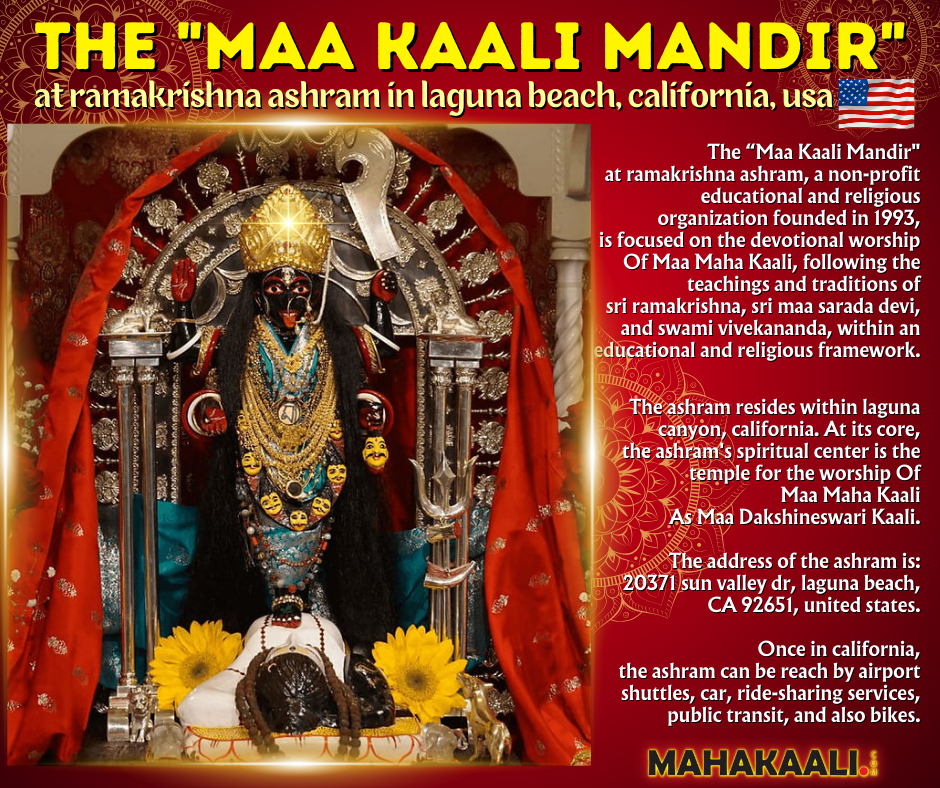
14. The “Maa Kaali Mandir” at ramakrishna ashram, laguna beach, california
A Temple for the worship Of Maa Maha Kaali As Maa Dakshineswari Kaali.
The “Maa Kaali Mandir” at ramakrishna ashram, a non-profit educational and religious organization founded in 1993, is focused on the devotional worship Of Maa Maha Kaali, following the teachings and traditions of sri ramakrishna, sri maa sarada devi, and swami vivekananda, within an educational and religious framework.
Background information
In 1993, a stunning Statue for the worship Of Maa Maha Kaali, originally from india, was ceremonially awakened by sri haradhan chakraborty, the late primary priest at “Dakshineswar Maa Kaali Temple” kolkata, india. He praised and worshipped Maa Maha Kaali As Sri Maa Dakshineswari Kaali. Followers, lacking extensive knowledge of india’s temple rituals, gradually embraced this profoundly rich devotional tradition, learning and incorporating its intricacies one step at a time, fueled by their simple love and desire to please and serve The Divine Mother. This uncomplicated daily devotion naturally evolved into the current “Maa Kaali Mandir” at ramakrishna ashram, where devotees can openly express their deep longing.
Location
The ashram resides within laguna canyon, california, a sacred location adorned by the natural wonders of laguna cove wilderness park, situated just two miles from the pacific ocean. At its core, the ashram’s spiritual center is the temple for the worship Of Maa Maha Kaali As Maa Dakshineswari Kaali.
The address of the ashram is: 20371 sun valley dr, laguna beach, CA 92651, united states.
Visiting hours
The temple visiting hours are as follows:
friday, saturday & sunday (by appointment only)
10am – 12 Noon & 3pm – 5pm
closed: monday through thursday
Appointments can be made at: https://www.kalimandir.org/visiting
How to reach the temple
Traveling to california, whether from inside the USA or from outside the country, can be done through various means of transportation. Here are the common ways to travel to california:
Travel within the USA:
- Air travel:
- Domestic flights: If you are within the USA, the most common and efficient way to travel to California is by taking a domestic flight to major airports like los angeles international airport (LAX), san francisco international airport (SFO), or san diego international airport (SAN).
- Regional airports: There are several regional airports throughout california that you can use for domestic flights within the USA.
- Bus travel:
- Long-distance bus services operate within the USA, such as greyhound and megabus, providing an affordable mode of travel to california from various states.
- Train travel:
- Amtrak offers train services to california from various states, with routes like the coast starlight and southwest chief providing scenic journeys to major cities in california.
- Driving:
- If you’re already in the USA, you can drive to california using your own vehicle or renting one. Interstate highways and roads connect california to neighboring states.
Travel from Outside the USA:
- International flights:
- If traveling from outside the USA, the primary means of transportation to california is by taking an international flight to major international airports in california, such as los angeles international airport (LAX) or san francisco international airport (SFO).
- Connecting flights:
- For travelers coming from countries outside the USA, connecting flights through major international hubs like los angeles (LAX), san francisco (SFO), or other international airports in the USA are common.
The ashram at laguna beach can be reached via:
Car: If you have access to a car or are renting one, driving is a convenient way to reach laguna beach. Laguna beach is accessible via major highways, including the pacific coast highway (california state route 1) and interstate 5.
Ridesharing (uber, lyft): You can use ridesharing services like uber or lyft to travel to laguna Beach from nearby locations. Simply use the app to request a ride to your desired destination.
Public Transit: Laguna Beach is served by orange county transportation authority (OCTA) buses. You can use OCTA’s trip planner on their website to find the best bus routes and schedules to get to Laguna Beach.
Airport shuttle: If you’re traveling from a nearby airport, consider using an airport shuttle service to laguna beach. Many shuttle companies offer transportation to and from airports in the area.
Taxi: Taxis are available in the area and can be hailed or booked in advance for transportation to Laguna Beach.
Bike: laguna beach is a bike-friendly area, and biking can be a pleasant way to explore the city and its surroundings.
Train: laguna beach does not have a direct train station. However, you can take a train to a nearby station, such as the laguna niguel/mission viejo metrolink station, and then use other transportation options like a taxi or rideshare to reach laguna beach.
For the most up-to-date and accurate transportation options, it’s recommended to use a navigation app or website to plan your journey based on your specific starting location and preferences.
References
https://www.kalimandir.org/about-us
https://www.facebook.com/KaliMandirRamakrishnaAshrama/
https://www.indianeagle.com/travelbeats/laguna-beach-kali-mandir-history/
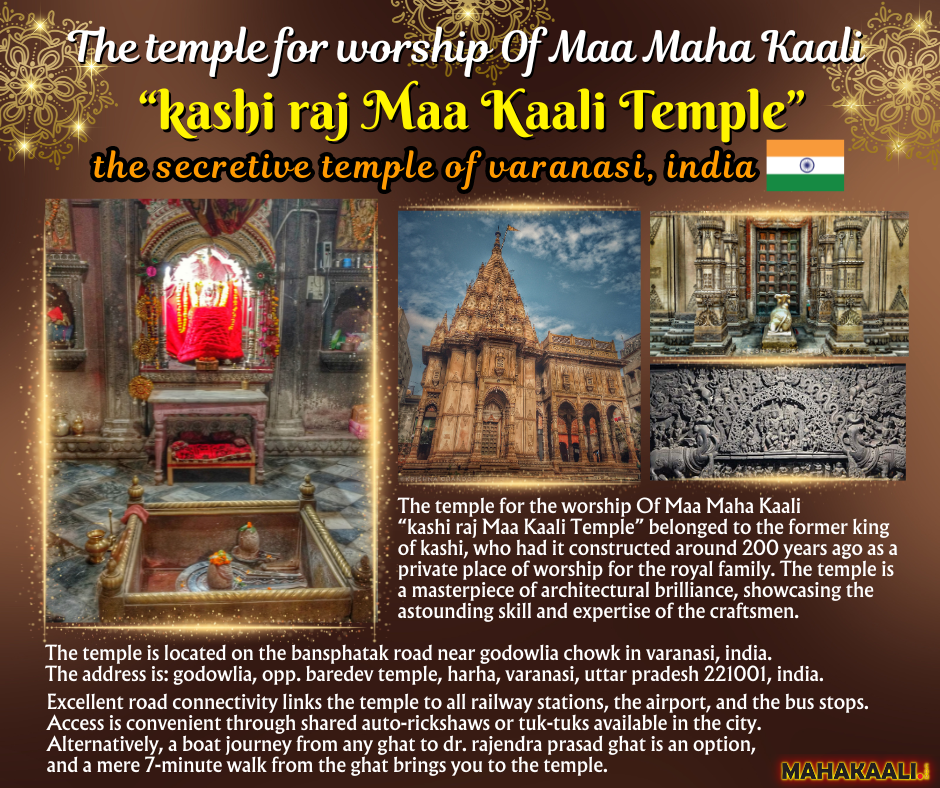
15. The temple for the worship Of Maa Maha Kaali “kashi raj Maa Kaali Temple” the secretive temple of varanasi, india
The temple for the worship Of Maa Maha Kaali “kashi raj Maa Kaali Temple” is located on the busy bansphatak road near godowlia chowk in varanasi, india. Upon initial observation, the temple appears akin to an ancient residence; however, upon entering its surroundings, one quickly discerns its true magnificence. The nearer you approach, the more captivating it becomes. The symmetrical layout and intricately carved details evoke a sense of perfection and regality, making it difficult to fathom the means by which it was crafted devoid of contemporary tools. This temple stands as a prime example of the highly advanced stonework craftsmanship prevalent in india.
Historical background
This temple belonged to the former king of kasi, who had it constructed around 200 years ago as a private place of worship for the royal family. Under his rule, only members of the royal lineage were granted permission to engage in worship within its walls.
However, as per the local accounts, the visible temple is purportedly a decoy concealing the true temple located beside it. While numerous legends surround this narrative, historical documentation on the matter is scarce. Legend has it that attempts to expand the original temple with additional floors or a dome led to the walls sinking into the ground. After several unsuccessful endeavors to add a dome, the decision was made to preserve the existing structure and construct a new one in front of it.
In the annals of varanasi’s history, the final king of kashi, distinct from the temple’s builder, plays a significant role. An alternative theory suggests that the king aimed to protect the sacred shivling from invaders by hiding the real temple. Consequently, he safeguarded the actual shivling in a small chamber and erected an elaborate facade in front. Visitors to the area are often captivated by the design’s aesthetics, inadvertently overlooking the inconspicuous modest white structure housing the revered shivling.
If this theory holds true, the king’s efforts to maintain the temple’s secrecy were evidently successful. Even situated along varanasi’s bustling thoroughfare, the temple remains inconspicuous, evading notice by passersby. Consequently, the temple attracts minimal foot traffic, preserving its tranquility throughout the year.
Architectural splendor
The temple is a masterpiece of architectural brilliance, showcasing the astounding skill and expertise of the craftsmen. Accessible via a flight of stone steps, the interior of the temple leaves visitors in awe, with every carving, ornate pillar, and decorative sculpture displaying remarkable artistry. The temple’s roof is exquisitely designed, featuring intricately chiseled stone elements like petals, bells, and rings, illustrating the temple’s grandeur and the advanced stone crafting prevalent in this region of india. The architectural excellence is not limited to the interior; even the outer aspect, particularly the finely carved temple complex gate, exemplifies this, akin to a symphony in stone.
Location
The “kashi raj Maa Kaali Temple” can be found along the bustling bansphatak road exactly two minutes walk away from godowlia chowk in varanasi, india. Despite its high accessibility, it stands out as one of the most challenging places to pinpoint in varanasi.
The address of the temple is: godowlia, opp. baredev temple, harha, varanasi, uttar pradesh 221001, india.
Visiting hours
The temple is open 24 hours or every day.
How to reach the temple
Traveling to varanasi, whether from outside india or within the country, involves considering various transportation options. Here’s a guide for both scenarios:
Traveling from outside india:
By air:
- Flight: The most common and efficient way is to book a flight to lal bahadur shastri international airport (VNS) in varanasi. There are direct international flights from major cities to varanasi.
By land:
- Train: If traveling from neighboring countries, for example nepal, you can reach the india-nepal border and then take a train to Varanasi, which is well-connected by rail.
Traveling within india:
By air:
- Flight: Varanasi is well-connected domestically, and you can book a flight to lal bahadur shastri international airport (VNS) from major indian cities.
By train:
- Train: Varanasi junction (BSB) is a major railway station, and there are numerous trains connecting varanasi to different parts of India. You can book tickets through the indian railways website or at the railway station.
By road:
- Bus: Varanasi is connected by a network of state and private buses. You can take a bus from nearby cities or states. Make sure to check the availability and book tickets in advance if possible.
- By car: If you prefer a more personalized journey, you can hire a taxi or rent a car to reach varanasi. The road network is decent, and you can plan your route accordingly.
Within Varanasi:
The temple sits close to godowlia chowk, situated along bansphatak road. Excellent road connectivity links it to all railway stations, the airport, and the bus stop. Access is convenient through shared auto-rickshaws or tuk-tuks available in the city. Alternatively, a boat journey from any ghat to dr. rajendra prasad ghat is an option, and a mere 7-minute walk from the ghat brings you to the temple.
References
https://www.varanasiguru.com/secret-temple-of-varanasi/
https://godsownweb.blogspot.com/2022/05/kasiraj-kali-temple-hidden-treasure-of.html
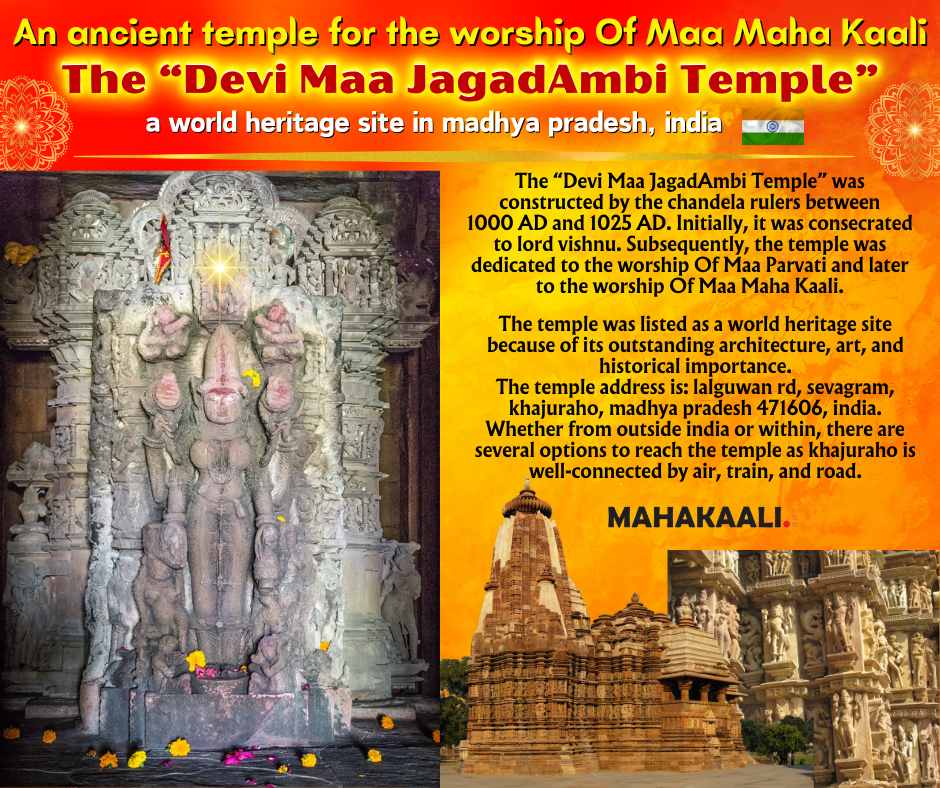
16. An ancient temple for the worship Of Maa Maha Kaali The “Devi Maa JagadAmbi Temple” is a world heritage site in madhya pradesh, india
The “Devi Maa JagadAmbi Temple”, also known as “Maa JagadAmbika Temple”, was constructed by the chandela rulers between 1000 AD and 1025 AD. Initially, it was consecrated to lord vishnu, as evidenced by the exquisite stone carvings depicting lord vishnu and his avatars on the temple’s lower tiers. Subsequently, the temple’s dedication shifted to the worship Of Maa Parvati and later to the worship Of Maa Maha Kaali. It is said that The Idol At the temple for the worship Of The Divine Mother First Was A Depiction Of Maa Parvati but was later colored in the colour black As A Depiction Of Maa Maha Kaali.
The temple was listed as a world heritage site because of its outstanding architecture, art, and historical importance.
The temple architecture
The temple exhibits a tripartite architectural structure, comprising a sanctum devoid of a circumambulatory path, a grand assembly hall (maha-mandapa), and an entrance portico. Within the inner sanctum, there Is The Holy Image Of Maa JagadAmbi.
The temple’s sculptures are arranged in three horizontal bands. While the lower two bands predominantly feature depictions of lord vishnu, the third and uppermost band of the temple showcases some of khajuraho’s most explicit and amorous sculptures. Additionally, at the temple’s entrance, one can observe a prominent sculpture depicting a warrior engaging in bare-handed combat with a lion, which is recognized as a symbol of the chandela dynasty.
Location
At a distance of 1 km from khajuraho bus stand, The “Devi Maa JagadAmbi Temple” is situated towards the north of kandariya mahadev temple in the historical town of khajuraho.
The address is: lalguwan rd, sevagram, khajuraho, madhya pradesh 471606, india
Visiting hours
The complex timing and entry fee are as follows:
Complex timings: 6 AM – 5 PM
Complex entry fee: Rs. 30 for indians, Rs. 500 for foreigners
It is important to note that timings and entry fee may change without any prior notice.
How to reach the temple
To travel to khajuraho, madhya pradesh, whether you are coming from outside india or within the country, you have several travel options. Khajuraho is well-connected by air, train, and road. Here are the details for both international and domestic travelers:
From outside india:
- By air: The most common way to reach khajuraho from outside india is to book an international flight to one of india’s major international airports, such as indira gandhi international airport in delhi or chhatrapati shivaji maharaj international airport in mumbai. Once you arrive in india, you can then take a domestic flight to khajuraho airport. Khajuraho has its domestic airport with regular flights from major Indian cities.
- By train: If you prefer to travel by train, you can arrive in India and then take a domestic flight or train to jhansi, which is the nearest major railway station to khajuraho. From jhansi, you can continue your journey to khajuraho by train or road. There are regular train services from major indian cities to jhansi.
From inside india:
- By air: The most straightforward way to reach khajuraho from within india is to book a domestic flight to khajuraho airport. Several major Indian cities, including delhi, Varanasi, and agra, have direct flights to khajuraho.
- By train: If you prefer traveling by train, you can take a train to jhansi railway station, which is well-connected to other major Indian cities. From jhansi, you can continue your journey to khajuraho by train or road.
- By road: Khajuraho is well-connected by road to nearby cities and towns. You can hire a taxi or take a bus from cities like jhansi, satna, or mahoba to reach khajuraho. While traveling by road allows you to enjoy the scenic countryside, it can be time-consuming.
- By bus: Some long-distance buses also connect khajuraho to cities like agra, varanasi, and other nearby destinations. The temple is 1km away from the khajuraho bus stand.
References
https://www.templepurohit.com/hindu-temple/devi-jagadambi-temple/
https://www.trawell.in/madhya-pradesh/khajuraho/devi-jagadambi-temple
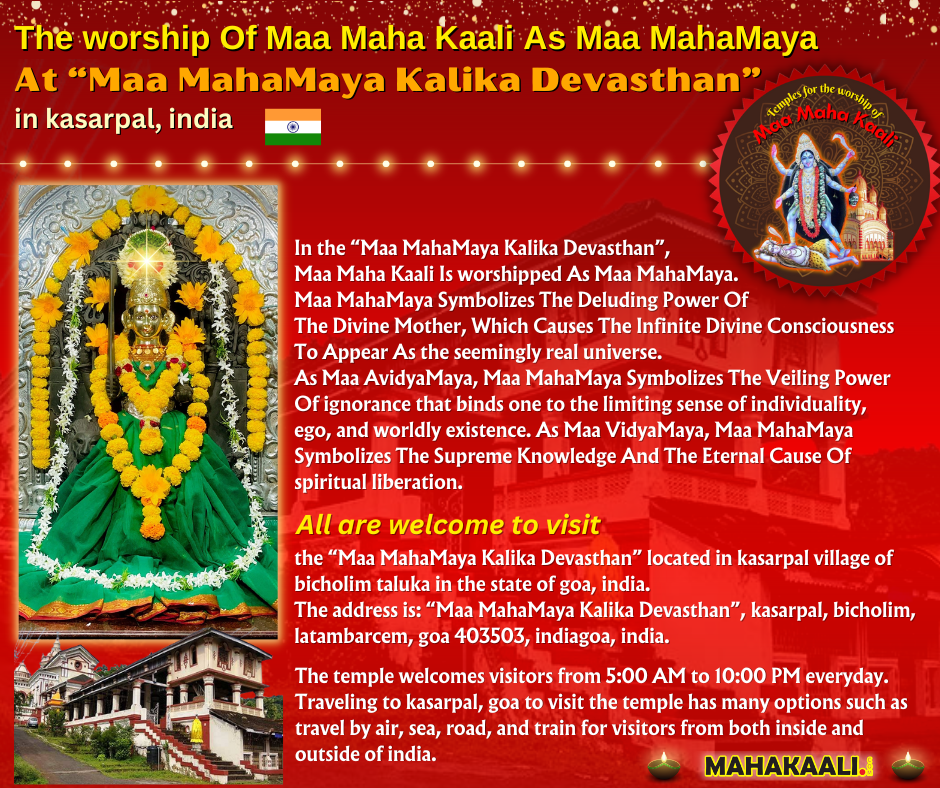
17. The worship Of Maa Maha Kaali As Maa MahaMaya At “Maa MahaMaya Kalika Devasthan”, in kasarpal, india
In the “Maa MahaMaya Kalika Devasthan”, Maa Maha Kaali Is worshipped by devotees As Maa MahaMaya. Maa MahaMaya Symbolizes The Deluding Power Of The Divine Mother, Which Causes The Infinite Divine Consciousness To Appear As the seemingly real universe.
Maa MahaMaya As Maa AvidyaMaya And Maa VidyaMaya
As Maa AvidyaMaya, Maa MahaMaya Symbolizes The Veiling Power Of ignorance that binds one to the limiting sense of individuality, ego, and worldly existence. Maa AvidyaMaya Produces entangling passions such as anger and greed, which keep one veiled in ignorance. As Maa AvidyaMaya, Maa MahaMaya Hurls even the so-called wise into the dark whirlpool of attachment. Having Seized their minds, Maa MahaMaya Binds them to this transitory existence (saṁsāra) and all its woes.
Maa MahaMaya As Maa VidyaMaya Is The Supreme Knowledge And The Eternal Cause Of spiritual liberation. Maa VidyaMaya Leads To knowledge, which liberates devotees by breaking every bond of worldly attachment. Maa VidyaMaya Blesses With qualities such as kindness, purity, and selflessness that can lead to spiritual liberation.
Maa Maha Kaali As Maa MahaMaya Is Symbolic Of The All Encompassing Power Of liberating knowledge as well as veiling ignorance. She Is Radiant Splendor And Terrifying Darkness, And Is The Ineffable Bliss Beyond all duality.
Temple location
“Maa MahaMaya Kalika Devasthan” is a temple complex in kasarpal village of bicholim taluka in the state of goa, india. It is one of the most important religious monuments in north goa situated at a distance of 18 kilometers from mapusa.
The address is: “Maa MahaMaya Kalika Devasthan”, kasarpal, bicholim, latambarcem, goa 403503, indiagoa, india.
Holy Idol
The Main Holy Idol for worship in the sanctum sanctorum of the temple Is more Than 800 Years Old. The Holy Idol Depicts Maa MahaMaya As Four-Armed, With Each Divine Hand Carrying Variously A Sword (Khadga), A Trident (Trishul), A Shield (Khetaka) And A Skull Bowl (Kapala), And The Divine Mother’s Mount Lion, Can Be Seen At Her Divine Feet.
Temple architecture
The temple is famous for its distinctive features and architectural marvels. Notably, a massive gold kalash (vessel) adorns the temple dome, contributing to its unique allure. Devotees from across the country and foreign visitors alike are drawn to the temple, finding solace and creating cherished memories.
Architecturally, the temple offers a spacious hall for public gatherings during festivals and meetings, known as sabhamantapa. Additionally, a nagarkhana, situated above the stage, resonates with the beats of drums and shehnai during specific times and rituals. The temple is a visual spectacle surrounded by agrashalas, adorned with two beautiful gates (praveshdwaras), and featuring a captivating lamp tower (deepastambha). The temple’s interior includes a main hall (chowk), a circumambulation path (sarwali), and the Sanctum sanctorum (garbhakud or garbhagruha), housing a remarkable golden kalasha.
Visiting hours
The temple is open to worshippers and visitors from 5:00 AM to 10:00 PM everyday.
How to reach the temple
Below is a general guidance on how to approach traveling to kasarpal from both outside and inside India.
Traveling to kasarpal from outside india:
By air:
- Fly to goa international airport (dabolim), which is the nearest international airport.
- From the airport, you can hire a taxi or use other local transportation to reach kasarpal. The distance from dabolim airport to kasarpal is approximately 45 kilometers.
By sea:
- Goa has a coastline, but passenger ships are not a common mode of transportation. Check for cruise options if available.
By train:
- The nearest major railway station is thivim railway station.
- From thivim, you can hire a taxi or use local transportation to reach kasarpal, which is approximately 20 kilometers away.
Traveling to kasarpal from inside india:
By air:
- Domestic flights operate to goa international airport (dabolim).
- Follow the same steps as mentioned for international travelers.
By road:
- Goa is well-connected by roads. You can take a bus or hire a taxi from nearby cities or towns.
- If you’re traveling from panaji, the capital of Goa, it’s approximately 20 kilometers to kasarpal.
By train:
- thivim railway station is the nearest major railway station.
- From thivim, proceed to kasarpal using local transportation.
Self-drive:
- If you prefer driving, goa has well-maintained roads. You can rent a car and drive to kasarpal.
References:
https://www.templepurohit.com/hindu-temples/goddess-kali/
https://www.templepurohit.com/hindu-temple/mahamaya-kalika-devasthan-kasarpal/
https://web.archive.org/web/20081002171004/http://www.kalikadevikasarpal.com/homepage.html
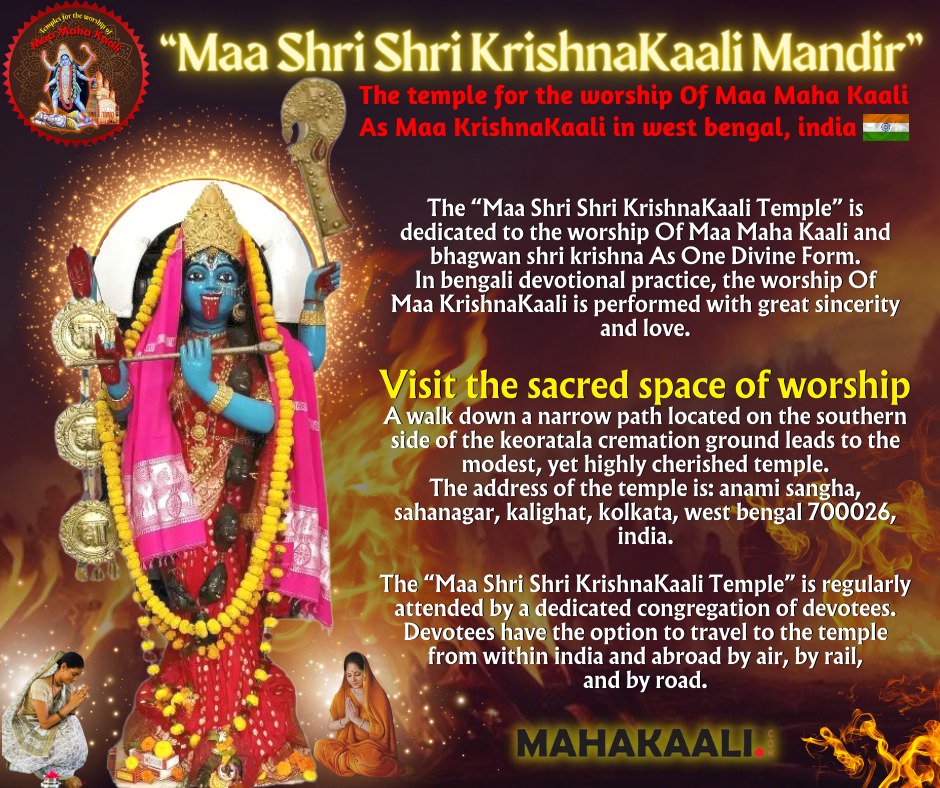
18. “Maa Shri Shri KrishnaKaali Mandir” The temple for the worship Of Maa Maha Kaali As Maa KrishnaKaali in west bengal, india
The “Maa Shri Shri KrishnaKaali Temple” is dedicated to the worship Of Maa Maha Kaali and bhagwan shri krishna As One Divine Form. In bengali devotional practice, the worship Of Maa KrishnaKaali is performed with great sincerity and love.
As per local folklore, ananda rishi, a devotee Of Maa Maha Kaali, established this temple approximately 150 years ago, engaging in intense sadhana or spiritual practice. Another sage named anathananda also performed sadhana here.
Holy Idol
In this temple, The Idol for worship Of Maa KrishnaKaali Is Depicted With Four Arms, With The Upper Left Hand Carrying A Kharga, And The Upper Right Hand Displayed In “abhaya mudra” (the “do not fear” gesture). The Two Lower Hands Are Depicted Holding The Flute of bhagwan shri krishna. Depicted With A Protruding Red Tongue, A Garland Of Severed human heads Around The Neck, And Dressed In Gorgeous Garments And Ornaments, The Idol Is Depicted With Blue Complexion And Stands In The Cross-Legged Contrapposto Stance characteristic of bhagwan shri krishna.
Temple location
A narrow path located on the southern side of the keoratala cremation ground leads to the modest, yet highly cherished temple. The address of the temple is: anami sangha, sahanagar, kalighat, kolkata, west bengal 700026, india
Visiting hours
The “Maa Shri Shri KrishnaKaali Temple” is regularly attended by a dedicated congregation of devotees. The temple is open to worshippers, devotees, and visitors between 5:00 AM to 2:00 PM in the morning and 5:00 PM to 10:30 PM during the evening.
How to visit the temple
To reach keoratala crematorium where the temple is situated, from within India and abroad, you can follow these general guidelines:
By air:
The nearest airport to kolkata is netaji subhas chandra bose international airport (CCU). From the airport, you can hire a taxi or use public transportation like buses to reach keoratala crematorium.
By train:
Kolkata has multiple railway stations. Howrah junction and sealdah are the main railway stations. You can reach either of these stations and then take a taxi or use local transport to reach keoratala crematorium.
By road:
If you are traveling within kolkata, you can use local taxis, auto-rickshaws, or app-based ride-sharing services to reach keoratala crematorium. If you are coming from outside kolkata, you can use long-distance buses or hire a taxi.
From abroad:
If you are coming from abroad, you can book a flight to netaji subhas chandra bose international airport in kolkata. Once you arrive at the airport, follow the instructions above to reach keoratala crematorium.
Link to google map of “Maa Shri Shri KrishnaKaali Mandir”: https://www.google.com/maps/dir//G88R%2BQHQ,+Anami+Sangha,+Sahanagar,+Kalighat,+Kolkata,+West+Bengal+700026,+India/@22.5169529,88.2590952,12z/data=!3m1!4b1!4m8!4m7!1m0!1m5!1m1!1s0x3a02774b2b369279:0x551e2388ca53d785!2m2!1d88.3414973!2d22.5169648?entry=ttu
References
https://yappe.in/west-bengal/kolkata/krishna-kali-temple/492476
https://www.kalibhakti.com/kalighat/
https://in.near-place.com/krishna-kali-temple-sahanagar-kalighat-kolkata
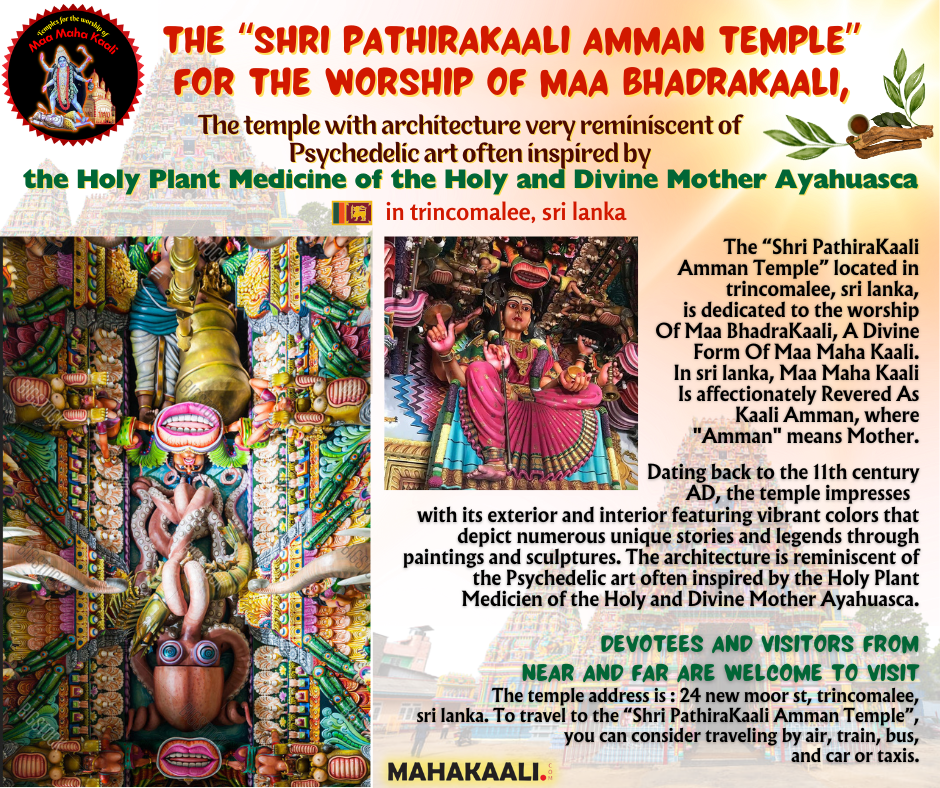
19. The “Shri PathiraKaali Amman Temple” for the worship Of Maa BhadraKaali, in trincomalee, sri lanka
The temple with architecture very reminiscent of Psychedelic art often inspired by the Holy Plant Medicine of the Holy and Divine Mother Ayahuasca
The “Shri PathiraKaali Amman Temple” also known as “Maa Kaali Kovil,” located in trincomalee, sri lanka, is dedicated to the worship Of Maa BhadraKaali, A Divine Form Of Maa Maha Kaali. In sri lanka, Maa Maha Kaali Is affectionately Revered As Kaali Amman, where “Amman” means Mother.
The “Shri PathiraKaali Amman Temple” is highly respected, not only by the followers of the Sanatana traditions but also by sinhalese buddhists in the island. Buddhists in trincomalee regularly participate in daily poojas (religious rituals) and make vows at this temple.
The history of this important temple dates back to the eleventh century AD when king rajendra cholan 1st ruled the country. However, according to professor of history dr. s. gunasingham, archaeological discoveries suggest that the temple’s history goes even further back than the eleventh century AD.
Temple architecture reminiscent of Psychedelic art often inspired by the Holy Plant Medicine of the Holy and Divine Mother Ayahuasca
The temple is built in a classical dravidian style. Dravidian architecture, or the southern indian temple style, is an architectural idiom in indian temple architecture that emerged from southern india, reaching its final form by the sixteenth century.
The temple impresses with its exterior featuring vibrant colors that depict numerous unique stories and legends through paintings and sculptures. The striking gopuram of the temple, adorned with vivid colors and diverse sculptures, attracts attention from afar. The captivating interiors are equally impressive, with walls adorned by many beautiful sculptures, showcasing exceptional craftsmanship. The temple art is also very reminiscent of Psychedelic art often inspired by the Holy Plant Medicine of the Holy and Divine Mother Ayahuasca.
Temple location
The “Shri PathiraKaali Amman Temple” is situated near konesar road esplanade, just before the entrance to konamamalai (swami rock). The temple is a part of the trincomalee koneswaram temple compounds, situated near trincomalee hindu college in the eastern province.
The address of the temple is: 24 new moor st, trincomalee, sri lanka.
Visiting hours
The “Shri PathiraKaali Amman Temple” attracts many worshippers and visitors from near and far. The temple timings are: 6:30 AM – 12 PM & 4 – 6:30 PM
The temple entry is free.
How to reach the temple
To travel to the “Shri PathiraKaali Amman Temple” in trincomalee, sri lanka, you can consider the following transportation options:
- By air:
- The nearest major airport is the bandaranaike international airport (CMB) in colombo.
- From colombo, you can take a domestic flight to the china bay airport in trincomalee, which is the closest airport to the city.
- By train:
- Trincomalee is well-connected by train services. You can take a train from colombo or other major cities to reach trincomalee railway station.
- The temple is 2 kms away from the railway station. From the railway station, you can hire a taxi or use local transportation to reach the “Shri PathiraKaali Amman Temple”.
- By bus:
- Sri lanka has an extensive bus network. You can take a bus from colombo or other major cities to reach trincomalee.
- Once in trincomalee, local buses or taxis can take you to the temple.
- By car:
- You can hire a car and drive to trincomalee. The journey offers scenic views, and it allows flexibility in exploring the surrounding areas.
- Make sure to check the local traffic rules and road conditions before embarking on a road trip.
- By tuk-tuk or taxi:
- Tuk-tuks (auto-rickshaws) and taxis are readily available in trincomalee. You can hire one to take you directly to the “Shri PathiraKaali Amman Temple”.
Before planning your trip, it’s advisable to check the current travel conditions, transportation schedules, and any travel restrictions that may be in place.
Link to the google map of the “Shri PathiraKaali Amman Temple”: https://www.google.com/maps/place/Shri+Badrakali+Amman+Hindu+Temple/@8.574781,81.234415,16z/data=!4m6!3m5!1s0x3afbbcb96e7ced71:0xcc19e628360afdc2!8m2!3d8.5747811!4d81.2344145!16s%2Fm%2F0h1dfwg?hl=en&entry=ttu
References
https://mydreamsofindia.blogspot.com/2019/01/trincomolee-sri-lanka-pathirakali-amman.html
https://www.tamilnet.com/art.html?catid=13&artid=8503
https://en.wikipedia.org/wiki/Pathirakali_Amman_Temple
https://www.trulysrilanka.com/attractions/sri-pathrakali-amman-temple.html
https://www.trawell.in/sri-lanka/trincomalee/pathirakali-amman-temple
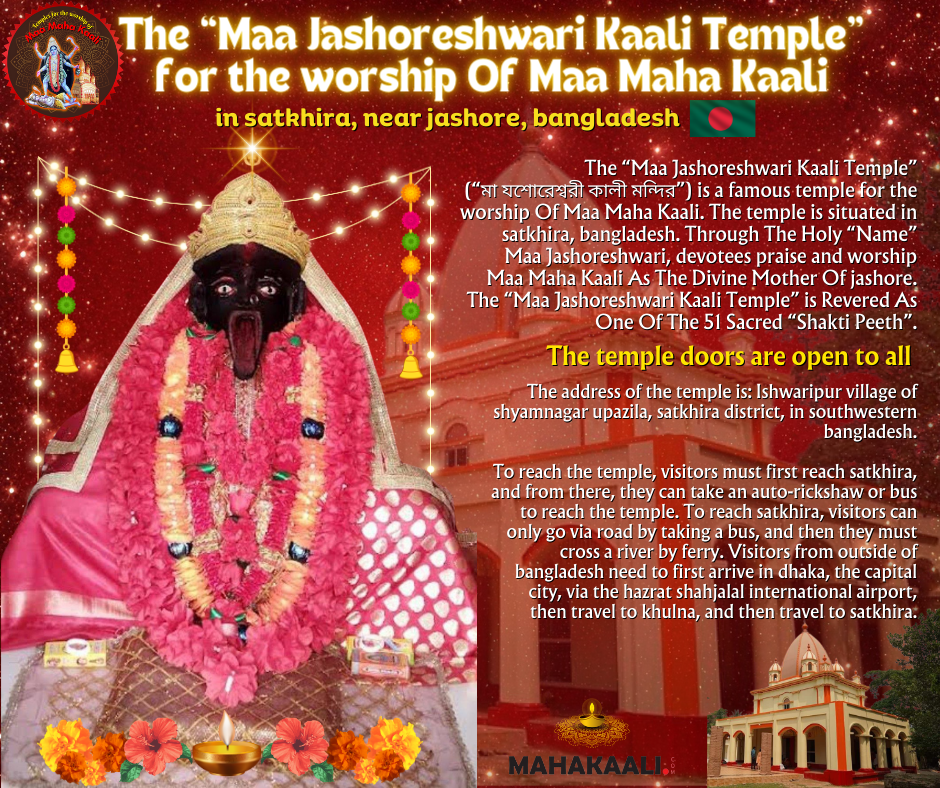
20. The “Maa Jashoreshwari Kaali Temple” for the worship Of Maa Maha Kaali, in satkhira, near jashore, bangladesh
The “Maa Jashoreshwari Kaali Temple” (“মা যশোরেশ্বরী কালী মন্দির”) is a famous temple for the worship Of Maa Maha Kaali. The temple is situated in satkhira (near jashore district), bangladesh. Through The Holy “Name” Maa Jashoreshwari, devotees praise and worship Maa Maha Kaali As The Divine Mother Of jashore.
The legend of “Maa Jashoreshwari Kaali Temple”
The “Maa Jashoreshwari Kaali Temple” is Revered As One Of The 51 Sacred “Shakti Peeth”. It is believed by devotees that the temple was built before the 13th century by a brahmin named anari. Brahmin anari is said to have created a 100-door temple originally, which was later renovated by general maharaja pratapaditya in the 13th century.
Temple location
The temple is located in Ishwaripur, a small village in shyamnagar upazila of satkhira in khulna, bangladesh. The address of the temple is: Ishwaripur village of shyamnagar upazila, satkhira district, in southwestern bangladesh.
Visiting hours
The temple typically opens in the morning and closes in the evening. Tourists from various countries visit the temple. The worship services take place every saturday and tuesday afternoon. Although there used to be a daily ritual before 1971, it has been stopped. Nevertheless, the temple hosts a vibrant “Maa Maha Kaali Puja” event every year, drawing both local and foreign visitors to its grounds.
Following the customary practice, visitors should dress modestly and remove their shoes before entering the temple grounds to show respect For The Sacred Site.
How to reach the temple
To reach the temple, visitors must first reach satkhira, and from there, they can take an auto-rickshaw or bus to reach the temple. To reach satkhira, visitors can only go via road by taking a bus, and then they must cross a river by ferry.
Visitors from outside of bangladesh need to first arrive in dhaka, the capital city, via the hazrat shahjalal international airport. The next steps are as follows:
- Travel to khulna: The nearest major city to satkhira is khulna. Visitors can reach khulna from dhaka by various means, such as domestic flights, buses, or trains. The train journey is quite scenic and comfortable, and they can take a train from kamalapur railway station in dhaka to khulna. The journey takes approximately 9-10 hours by train.
- Khulna to satkhira: From khulna, visitors will need to travel to satkhira, where the temple is situated. Visitors can do this by road, taking a bus or hiring a car. The journey from khulna to satkhira is approximately 2-3 hours by road, depending on traffic and road conditions.
- Reaching the temple: After arriving in satkhira, a visitor can hire a local vehicle, like a rickshaw or a CNG (auto-rickshaw), to take them to the temple.
Visitors should always verify the latest travel information, including visa requirements (if from outside bangladesh), transportation options, and safety guidelines, from official sources or local authorities before planning the journey, as circumstances can change.
Link to the google map of The “Maa Jashoreshwari Kaali Temple”
References
https://en.wikipedia.org/wiki/Jeshoreshwari_Kali_Temple
https://famoustemplesofindia.com/jeshoreshwari-kali-temple-bangladesh/
https://www.guidedtirth.com/en/destination/bangladesh/satkhira/jeshoreshwari-kali-temple/
https://www.alightindia.com/yashore-yashoreswari-jeshoreshwari
https://www.astroved.com/astropedia/en/temples/east-india/jeshoreshwari-kali-temple